ISTRUZIONI PER LA POSA A
COLLA SU MASSETTO
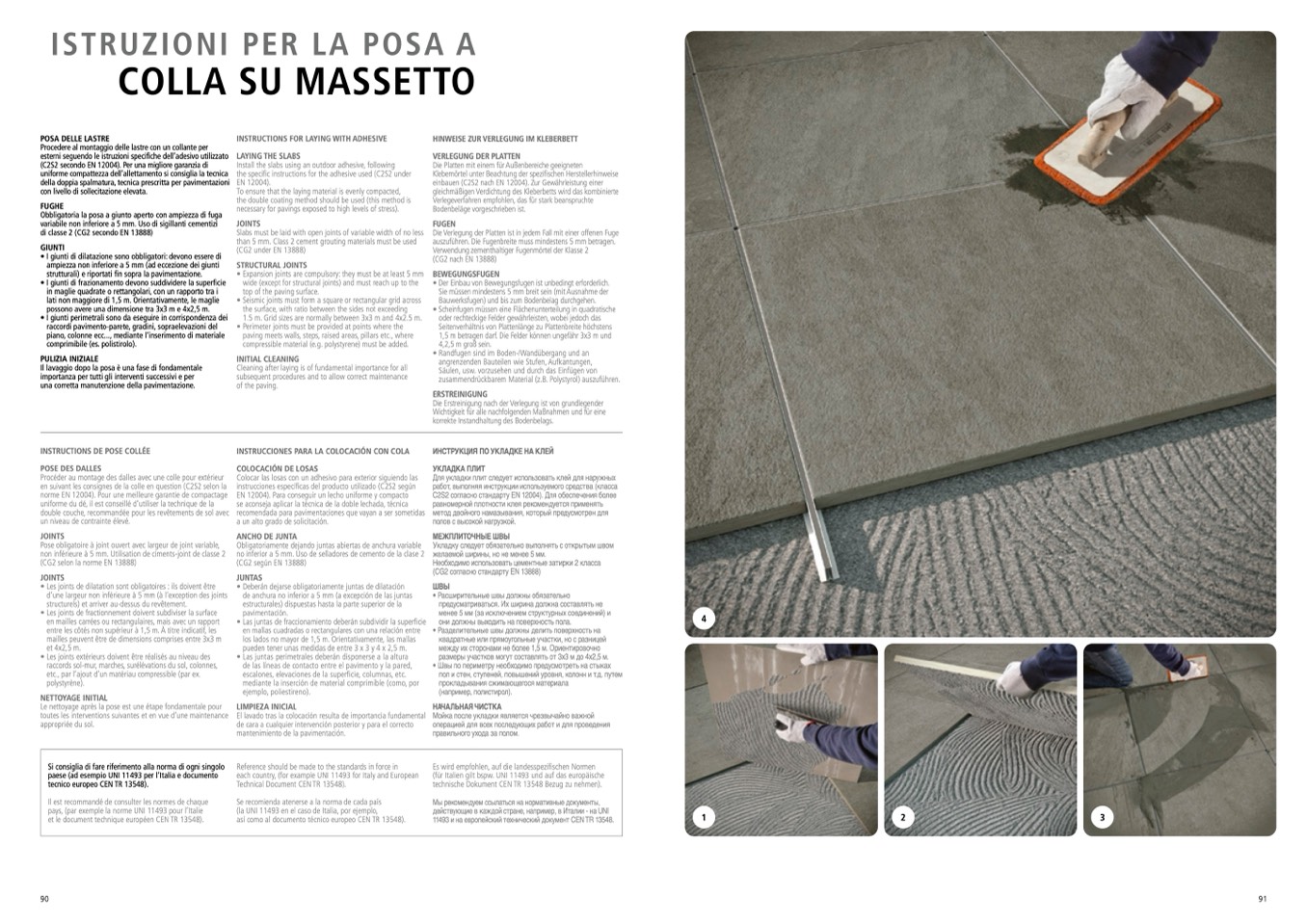
POSA DELLE LASTRE
Procedere al montaggio delle lastre con un collante per
esterni seguendo le istruzioni specifiche dell’adesivo utilizzato
(C2S2 secondo EN 12004). Per una migliore garanzia di
uniforme compattezza dell’allettamento si consiglia la tecnica
della doppia spalmatura, tecnica prescritta per pavimentazioni
con livello di sollecitazione elevata.
FUGHE
Obbligatoria la posa a giunto aperto con ampiezza di fuga
variabile non inferiore a 5 mm. Uso di sigillanti cementizi
di classe 2 (CG2 secondo EN 13888)
GIUNTI
• I giunti di dilatazione sono obbligatori: devono essere di
ampiezza non inferiore a 5 mm (ad eccezione dei giunti
strutturali) e riportati fin sopra la pavimentazione.
• I giunti di frazionamento devono suddividere la superficie
in maglie quadrate o rettangolari, con un rapporto tra i
lati non maggiore di 1,5 m. Orientativamente, le maglie
possono avere una dimensione tra 3x3 m e 4x2,5 m.
• I giunti perimetrali sono da eseguire in corrispondenza dei
raccordi pavimento-parete, gradini, sopraelevazioni del
piano, colonne ecc..., mediante l’inserimento di materiale
comprimibile (es. polistirolo).
PULIZIA INIZIALE
Il lavaggio dopo la posa è una fase di fondamentale
importanza per tutti gli interventi successivi e per
una corretta manutenzione della pavimentazione.
INSTRUCTIONS DE POSE COLLÉE
POSE DES DALLES
Procéder au montage des dalles avec une colle pour extérieur
en suivant les consignes de la colle en question (C2S2 selon la
norme EN 12004). Pour une meilleure garantie de compactage
uniforme du dé, il est conseillé d’utiliser la technique de la
double couche, recommandée pour les revêtements de sol avec
un niveau de contrainte élevé.
JOINTS
Pose obligatoire à joint ouvert avec largeur de joint variable,
non inférieure à 5 mm. Utilisation de ciments-joint de classe 2
(CG2 selon la norme EN 13888)
JOINTS
• Les joints de dilatation sont obligatoires : ils doivent être
d’une largeur non inférieure à 5 mm (à l’exception des joints
structurels) et arriver au-dessus du revêtement.
• Les joints de fractionnement doivent subdiviser la surface
en mailles carrées ou rectangulaires, mais avec un rapport
entre les côtés non supérieur à 1,5 m. À titre indicatif, les
mailles peuvent être de dimensions comprises entre 3x3 m
et 4x2,5 m.
• Les joints extérieurs doivent être réalisés au niveau des
raccords sol-mur, marches, surélévations du sol, colonnes,
etc., par l’ajout d’un matériau compressible (par ex.
polystyrène).
NETTOYAGE INITIAL
Le nettoyage après la pose est une étape fondamentale pour
toutes les interventions suivantes et en vue d’une maintenance
appropriée du sol.
INSTRUCTIONS FOR LAYING WITH ADHESIVE
LAYING THE SLABS
Install the slabs using an outdoor adhesive, following
the specific instructions for the adhesive used (C2S2 under
EN 12004).
To ensure that the laying material is evenly compacted,
the double coating method should be used (this method is
necessary for pavings exposed to high levels of stress).
JOINTS
Slabs must be laid with open joints of variable width of no less
than 5 mm. Class 2 cement grouting materials must be used
(CG2 under EN 13888)
STRUCTURAL JOINTS
• Expansion joints are compulsory: they must be at least 5 mm
wide (except for structural joints) and must reach up to the
top of the paving surface.
• Seismic joints must form a square or rectangular grid across
the surface, with ratio between the sides not exceeding
1.5 m. Grid sizes are normally between 3x3 m and 4x2.5 m.
• Perimeter joints must be provided at points where the
paving meets walls, steps, raised areas, pillars etc., where
compressible material (e.g. polystyrene) must be added.
INITIAL CLEANING
Cleaning after laying is of fundamental importance for all
subsequent procedures and to allow correct maintenance
of the paving.
INSTRUCCIONES PARA LA COLOCACIÓN CON COLA
COLOCACIÓN DE LOSAS
Colocar las losas con un adhesivo para exterior siguiendo las
instrucciones específicas del producto utilizado (C2S2 según
EN 12004). Para conseguir un lecho uniforme y compacto
se aconseja aplicar la técnica de la doble lechada, técnica
recomendada para pavimentaciones que vayan a ser sometidas
a un alto grado de solicitación.
ANCHO DE JUNTA
Obligatoriamente dejando juntas abiertas de anchura variable
no inferior a 5 mm. Uso de selladores de cemento de la clase 2
(CG2 según EN 13888)
JUNTAS
• Deberán dejarse obligatoriamente juntas de dilatación
de anchura no inferior a 5 mm (a excepción de las juntas
estructurales) dispuestas hasta la parte superior de la
pavimentación.
• Las juntas de fraccionamiento deberán subdividir la superficie
en mallas cuadradas o rectangulares con una relación entre
los lados no mayor de 1,5 m. Orientativamente, las mallas
pueden tener unas medidas de entre 3 x 3 y 4 x 2,5 m.
• Las juntas perimetrales deberán disponerse a la altura
de las líneas de contacto entre el pavimento y la pared,
escalones, elevaciones de la superficie, columnas, etc.
mediante la inserción de material comprimible (como, por
ejemplo, poliestireno).
LIMPIEZA INICIAL
El lavado tras la colocación resulta de importancia fundamental
de cara a cualquier intervención posterior y para el correcto
mantenimiento de la pavimentación.
HINWEISE ZUR VERLEGUNG IM KLEBERBETT
VERLEGUNG DER PLATTEN
Die Platten mit einem für Außenbereiche geeigneten
Klebemörtel unter Beachtung der spezifischen Herstellerhinweise
einbauen (C2S2 nach EN 12004). Zur Gewährleistung einer
gleichmäßigen Verdichtung des Kleberbetts wird das kombinierte
Verlegeverfahren empfohlen, das für stark beanspruchte
Bodenbeläge vorgeschrieben ist.
FUGEN
Die Verlegung der Platten ist in jedem Fall mit einer offenen Fuge
auszuführen. Die Fugenbreite muss mindestens 5 mm betragen.
Verwendung zementhaltiger Fugenmörtel der Klasse 2
(CG2 nach EN 13888)
BEWEGUNGSFUGEN
• Der Einbau von Bewegungsfugen ist unbedingt erforderlich.
Sie müssen mindestens 5 mm breit sein (mit Ausnahme der
Bauwerksfugen) und bis zum Bodenbelag durchgehen.
• Scheinfugen müssen eine Flächenunterteilung in quadratische
oder rechteckige Felder gewährleisten, wobei jedoch das
Seitenverhältnis von Plattenlänge zu Plattenbreite höchstens
1,5 m betragen darf. Die Felder können ungefähr 3x3 m und
4,2,5 m groß sein.
• Randfugen sind im Boden-/Wandübergang und an
angrenzenden Bauteilen wie Stufen, Aufkantungen,
Säulen, usw. vorzusehen und durch das Einfügen von
zusammendrückbarem Material (z.B. Polystyrol) auszuführen.
ERSTREINIGUNG
Die Erstreinigung nach der Verlegung ist von grundlegender
Wichtigkeit für alle nachfolgenden Maßnahmen und für eine
korrekte Instandhaltung des Bodenbelags.
ИНСТРУКЦИЯ ПО УКЛАДКЕ НА КЛЕЙ
УКЛАДКА ПЛИТ
Для укладки плит следует использовать клей для наружных
работ, выполняя инструкции используемого средства (класса
C2S2 согласно стандарту EN 12004). Для обеспечения более
равномерной плотности клея рекомендуется применять
метод двойного намазывания, который предусмотрен для
полов с высокой нагрузкой.
МЕЖПЛИТОЧНЫЕ ШВЫ
Укладку следует обязательно выполнять с открытым швом
желаемой ширины, но не менее 5 мм.
Необходимо использовать цементные затирки 2 класса
(CG2 согласно стандарту EN 13888)
ШВЫ
• Расширительные швы должны обязательно
предусматриваться. Их ширина должна составлять не
менее 5 мм (за исключением структурных соединений) и
они должны выходить на поверхность пола.
• Разделительные швы должны делить поверхность на
квадратные или прямоугольные участки, но с разницей
между их сторонами не более 1,5 м. Ориентировочно
размеры участков могут составлять от 3x3 м до 4x2,5 м.
• Швы по периметру необходимо предусмотреть на стыках
пол и стен, ступеней, повышений уровня, колонн и т.д. путем
прокладывания сжимающегося материала
(например, полистирол).
НАЧАЛЬНАЯ ЧИСТКА
Мойка после укладки является чрезвычайно важной
операцией для всех последующих работ и для проведения
правильного ухода за полом.
4
Si consiglia di fare riferimento alla norma di ogni singolo
paese (ad esempio UNI 11493 per l’Italia e documento
tecnico europeo CEN TR 13548).
Il est recommandé de consulter les normes de chaque
pays, (par exemple la norme UNI 11493 pour l’Italie
et le document technique européen CEN TR 13548).
Reference should be made to the standards in force in
each country, (for example UNI 11493 for Italy and European
Technical Document CEN TR 13548).
Se recomienda atenerse a la norma de cada país
(la UNI 11493 en el caso de Italia, por ejemplo,
así como al documento técnico europeo CEN TR 13548).
Es wird empfohlen, auf die landesspezifischen Normen
(für Italien gilt bspw. UNI 11493 und auf das europäische
technische Dokument CEN TR 13548 Bezug zu nehmen).
Мы рекомендуем ссылаться на нормативные документы,
действующие в каждой стране, например, в Италии - на UNI
11493 и на европейский технический документ CENTR 13548.
90
91
1
2
3

