General information
Useful calculation data
ISO 9001
P
2
Example
11.5.7
P
2
Cert. No. LRQ 0963008
Note: = Kv √ P
1
,
Water
Valve Sizing Chart
= Water flow (m
3
/ h), P
1
= Pressure drop across the valve (bar),
This chart assumes no cavitation after the control valve.
TI-GCM-09
CM Issue 1
Kv = Flow coefficient (m
3
/ h bar).
P
1
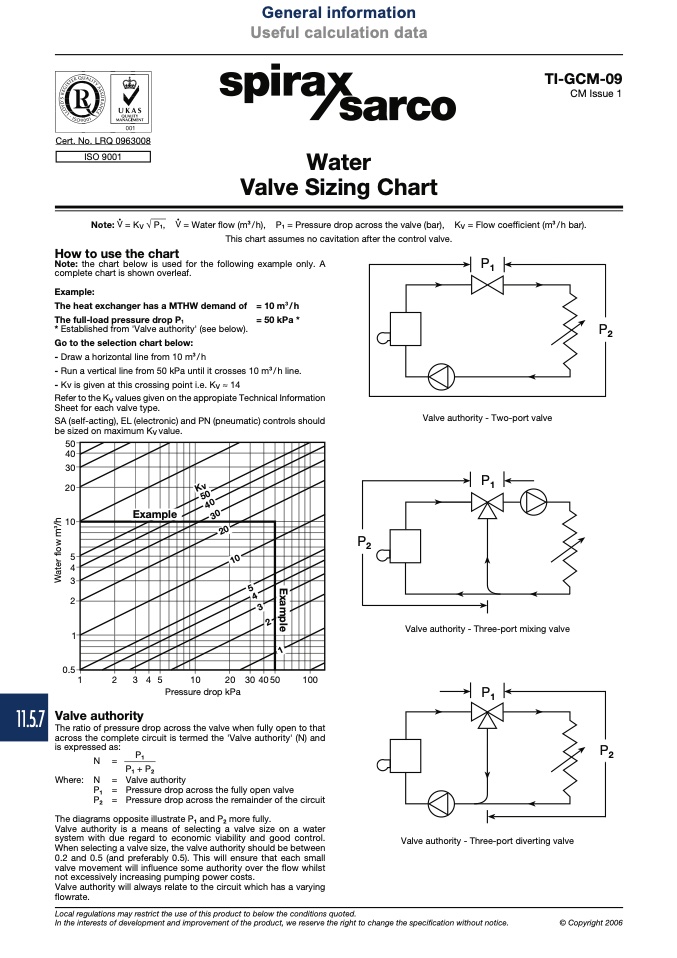
How to use the chart
Note: the chart below is used for the following example only. A
complete chart is shown overleaf.
Example:
The heat exchanger has a MTHW demand of
The full-load pressure drop P
1
* Established from 'Valve authority' (see below).
Go to the selection chart below:
- Draw a horizontal line from 10 m
3
/ h
= 10 m
3
/ h
= 50 kPa *
- Run a vertical line from 50 kPa until it crosses 10 m
3
/ h line.
- Kv is given at this crossing point i.e. Kv 14
Refer to the Kv values given on the appropiate Technical Information
Sheet for each valve type.
SA (self-acting), EL (electronic) and PN (pneumatic) controls should
be sized on maximum Kv value.
Valve authority - Two-port valve
P
1
��
��
��
��
��
�
�
�
�
�
P
2
���
�
�
���
��
�
�
������
���
������������������
Valve authority
The ratio of pressure drop across the valve when fully open to that
across the complete circuit is termed the 'Valve authority' (N) and
Valve authority - Three-port mixing valve
P
1
Valve authority - Three-port diverting valve
is expressed as:
N =
Where: N =
P
1
=
P
2
=
P
1
P
1
+ P
2
Valve authority
Pressure drop across the fully open valve
Pressure drop across the remainder of the circuit
The diagrams opposite illustrate P
1
and P
2
more fully.
Valve authority is a means of selecting a valve size on a water
system with due regard to economic viability and good control.
When selecting a valve size, the valve authority should be between
0.2 and 0.5 (and preferably 0.5). This will ensure that each small
valve movement will influence some authority over the flow whilst
not excessively increasing pumping power costs.
Valve authority will always relate to the circuit which has a varying
flowrate.
Local regulations may restrict the use of this product to below the conditions quoted.
In the interests of development and improvement of the product, we reserve the right to change the specification without notice.
© Copyright 2006
��
��
��
��
��
��
�
�
�
�
�
�
�
�
�
�
�
�
�
�
�
�
�
�
�
�
E
x
a
m
p
l
e

