Pipeline ancillaries
Separators and insulation jackets
7.8.9
ISO 9001
A
Steam
saturation
curve
B
A
TI-P023-24
ST Issue 4
Cert. No. LRQ 0963008
S3
Cast Iron
Separator (Flanged)
2
3
1
4
Description
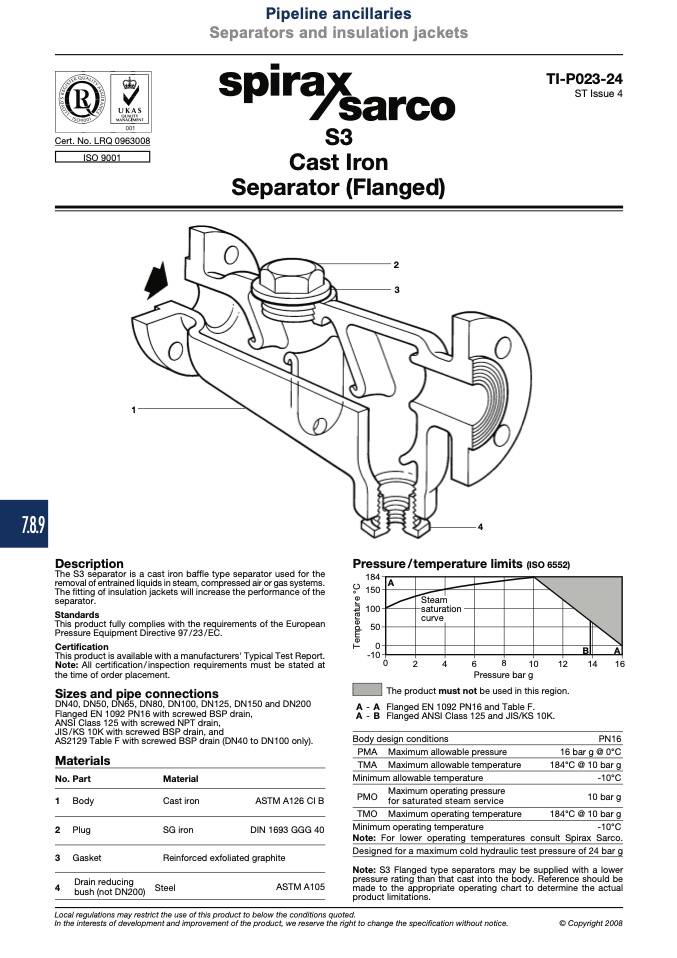
The S3 separator is a cast iron baffle type separator used for the
removal of entrained liquids in steam, compressed air or gas systems.
The fitting of insulation jackets will increase the performance of the
separator.
Standards
This product fully complies with the requirements of the European
Pressure Equipment Directive 97/23/EC.
Certification
This product is available with a manufacturers' Typical Test Report.
Note: All certification/inspection requirements must be stated at
the time of order placement.
Sizes and pipe connections
DN40, DN50, DN65, DN80, DN100, DN125, DN150 and DN200
Flanged EN 1092 PN16 with screwed BSP drain,
ANSI Class 125 with screwed NPT drain,
JIS/KS 10K with screwed BSP drain, and
AS2129 Table F with screwed BSP drain (DN40 to DN100 only).
Pressure/temperature limits (ISO 6552)
���
���
���
��
�
���
�
�
�
�
�
��
��
��
��
Pressure bar g
The product must not be used in this region.
A - A Flanged EN 1092 PN16 and Table F.
A - B Flanged ANSI Class 125 and JIS/KS 10K.
Body design conditions
Materials
No. Part
1 Body
2 Plug
3 Gasket
Drain reducing
Local regulations may restrict the use of this product to below the conditions quoted.
In the interests of development and improvement of the product, we reserve the right to change the specification without notice.
© Copyright 2008
PMA Maximum allowable pressure
TMA Maximum allowable temperature
Minimum allowable temperature
PMO
Maximum operating pressure
for saturated steam service
TMO Maximum operating temperature
Minimum operating temperature
PN16
16 bar g @ 0°C
184°C @ 10 bar g
-10°C
10 bar g
184°C @ 10 bar g
Material
Cast iron
SG iron
Reinforced exfoliated graphite
-10°C
Note: For lower operating temperatures consult Spirax Sarco.
ASTM A126 CI B
DIN 1693 GGG 40
4
bush (not DN200)
Steel
ASTM A105
Designed for a maximum cold hydraulic test pressure of 24 bar g
Note: S3 Flanged type separators may be supplied with a lower
pressure rating than that cast into the body. Reference should be
made to the appropriate operating chart to determine the actual
product limitations.
T
e
m
p
e
r
a
t
u
r
e
°
C

