Installation advic
e
Consigli di posa. Conseils de pose. Verlegehinweise
.
1.
NO CLAIMS WILL BE ACCEPTED FOR LAID MATERIALS
.
2.
CHECK THE SHADE, WORKSIZE, SELECTION AND THE WARPAGE BEFOR
E
LAYING THE MATERIAL
.
3.
ELECTRONIC MACHINES THAT SET THE WORKSIZE ARE CALIBRATED WIT
H
A TOLERANCE OF 1.2 mm
.
4.
THE MATERIAL MUST BE LAID WITH A MINIMUM JOINT OF 3 mm
.
THE RECTIFIED MATERIAL MUST BE LAID WITH A MINIMUM JOINT OF 2 mm.
The "Campigiane" series (thin paving bricks) must be laid with a joint of 5 mm
.
RECOMMENDATIONS FOR INSTALLATIO
N
When setting the tiles, pls chec tone, caliber and choice. Our material is deliberatel
y
produced and chosen with slight differences in shade which underline the colou
r
effect it is absolutely necessary to use tiles from different boxes when installing. Th
e
use of material different from the order or defective means acceptance of the quality
characteristics of the goods and excludes complaints. Complaints about material alread
y
installed will not be accepted.
INSTALLATION SUGGESTIONS FOR ALL RECTANGULAR FORMATS
IN THE CATALOGU
E
You will
find a few suggestions for making the most of the product at the installation
stage. A basic strategy to adopt when laying our product is to carefully alternate the
different shades taking the tiles three or four at a time from at least five different boxes
.
Harmoniously distribute the various shades thet are most striking and check the result
from time to time, surveying the section of work done, from a suitable distance. The
materials should be checked before installation and put aside if they are defectiv
e
because no compliants will be accepted that have already been installed.
INSTALLATION OF RECTIFIED MATERIALS
For the installation of rectified materials it is anyway essential to keep a gap between
the tiles of at least 2/3 mm. Using grouts and sealers that are colour co-ordinate
d
with the material. When laying rectangular recti
fied material, it is important to avoid
placing the edges of each tile next to the halves of others in order to compensate for
any imperfections in flatness that are, however, always present in large sizes. As this i
s
cut and recti
fied material to avoid the problem it is recommended to lay the material i
n
a straightforward design with an interval from 0 to 15 cm. Between each tile as per the
pattern shown below. It is highly suggested to have the installation done by qualified
experts who, after checking the proper
flatness of the concrete slab and the quality of the
material, will contribute to carrying out of the job
flawlessly.
WASHING AFTER INSTALLATION
Washing after installation is a very important, fundamental phase for all later interventions
and for the maintenance. The following is achieved by washing after the installation:
- Remove installation residue (mortar, adhesive, paint and various types of dirt
in general)
.
- Remove any residue from the surface of the material
.
It’s an important fact to know that over 90% of claims in building sites are due to a ba
d
washing procedure or even due to the lack of washing after installation.
WATER RUNOFF ON RAISED FLOORS:
We recommend you give the floor a slight slope (at least 2%).
We recommend you use metal clips to fasten each slab in order to break the surfac
e
tension of the water in the event of pooling, thereby aiding runoff.
We recommend that you always use a central support for every floor tile laid.
TH2.0:
Gres protector - Faber
Enhancer Plus - Faber
Stop Dirty - Fil
a
1.
NON SI ACCETTANO CONTESTAZIONI PER MATERIALE POSATO.
2.
CONTROLLARE TONO, CALIBRO, SCELTA E PLANARITA’ PRIMA DELLA POSA
DEL MATERIALE.
3.
4.
LE MACCHINE ELETTRONICHE CHE STABILISCONO IL CALIBRO SON
O
TARATE CON UNA TOLLERANZA DI 1,2 mm.
IL MATERIALE DEVE ESSERE POSATO CON UN MINIMO DI FUGA DI 3 mm.
IL MATERIALE RETTIFICATO DEVE ESSERE POSATO CON UNA FUGA MINIMA
DI 2 mm.
Le serie "Campigiane" devono essere posate con una fuga di 5 mm
.
CONSIGLI PER LA POSA
In preparazione della posa, si raccomanda di controllare il tono, il calibro e la scelta. I
l
nostro materiale è deliberatamente prodotto e scelto con leggere differenze di tonalità
che esaltano gli effetti delle grafiche e dei colori. È inoltre necessario utilizzare durante
la posa, piastrelle prelevate da scatole diverse. L’utilizzo di materiale diverso da quello
ordinato o difettoso significa l’accettazione delle caratteristiche qualitative ed esclude
contestazioni. Contestazioni sul materiale già posato non sono accettate.
CONSIGLI PER LA POSA DI TUTTI I FORMATI RETTANGOLARI A CATALOG
O
Di seguito indichiamo alcuni consigli per valorizzare le caratteristiche del prodotto in fas
e
di posa. Un accorgimento basilare per la posa del nostro prodotto è quello di alternar
e
con cura le differenti tonalità prelevando le piastrelle a gruppi di 3-4 pezzi per volta
da almeno cinque scatole diverse. Distribuire in modo armonioso le diverse nuance
s
di colore che si evidenziano e controllare il risultato di tanto in tanto, osservando da
opportuna distanza una porzione di lavoro eseguita.
POSA MATERIALI RETTIFICATI
Per la posa dei materiali retti
ficati è comunque sempre indispensabile mantenere un
a
fuga minima di 2/3 mm. Da una piastrella all’altra usufruendo di stucchi e sigillanti
di colore coordinato a quello del materiale. Nella posa dei materiali retti
ficati rettangolari,
è importante evitare di far collimare i vertici di una piastrella con la metà delle altre, al fine
di sopperire alle eventuali imperfezioni di planarità presenti comunque in tutti i grandi
formati. Trattandosi di materiale tagliato e rettificato, per evitare questo problema, è
consigliabile posare il materiale a correre, con intervallo da 0 a 15 cm.
È fortemente auspicabile affidare la posa a personale esperto che, dopo aver verificato
la corretta planarità della caldana e la qualità del materiale, contribuirà alla impeccabile
esecuzione dell’incarico
.
LAVAGGIO DOPO POS
A
Il lavaggio dopo posa è una fase di fondamentale importanza per tutti gli interventi
successivi e per la manutenzione. Con il lavaggio dopo posa:
- Si eliminano i residui di posa (malta, colla, vernice, sporco da cantiere di varia natura)
.
- Si rimuovono eventuali residui super
ficiali del materiale.
È bene sapere che oltre il 90% delle contestazioni in cantiere è dovuto ad un cattivo, o
addirittura inesistente, lavaggio dopo posa.
REFLUSSO DELLE ACQUE SU POSE SOPRAELEVATE:
Si consiglia di dare una pendenza al pavimento con una percentuale non inferiore all'2%.
Si consiglia l’uso di Clip metalliche da inserire tra ogni singola lastra per rompere la
tensione superficiale dell’acqua in caso di ristagni, migliorandone il reflusso
.
TH2.0
:
Gres protector - Faber
Enhancer Plus - Faber
Stop Dirty - Fil
a
7,5 / 15 c
m
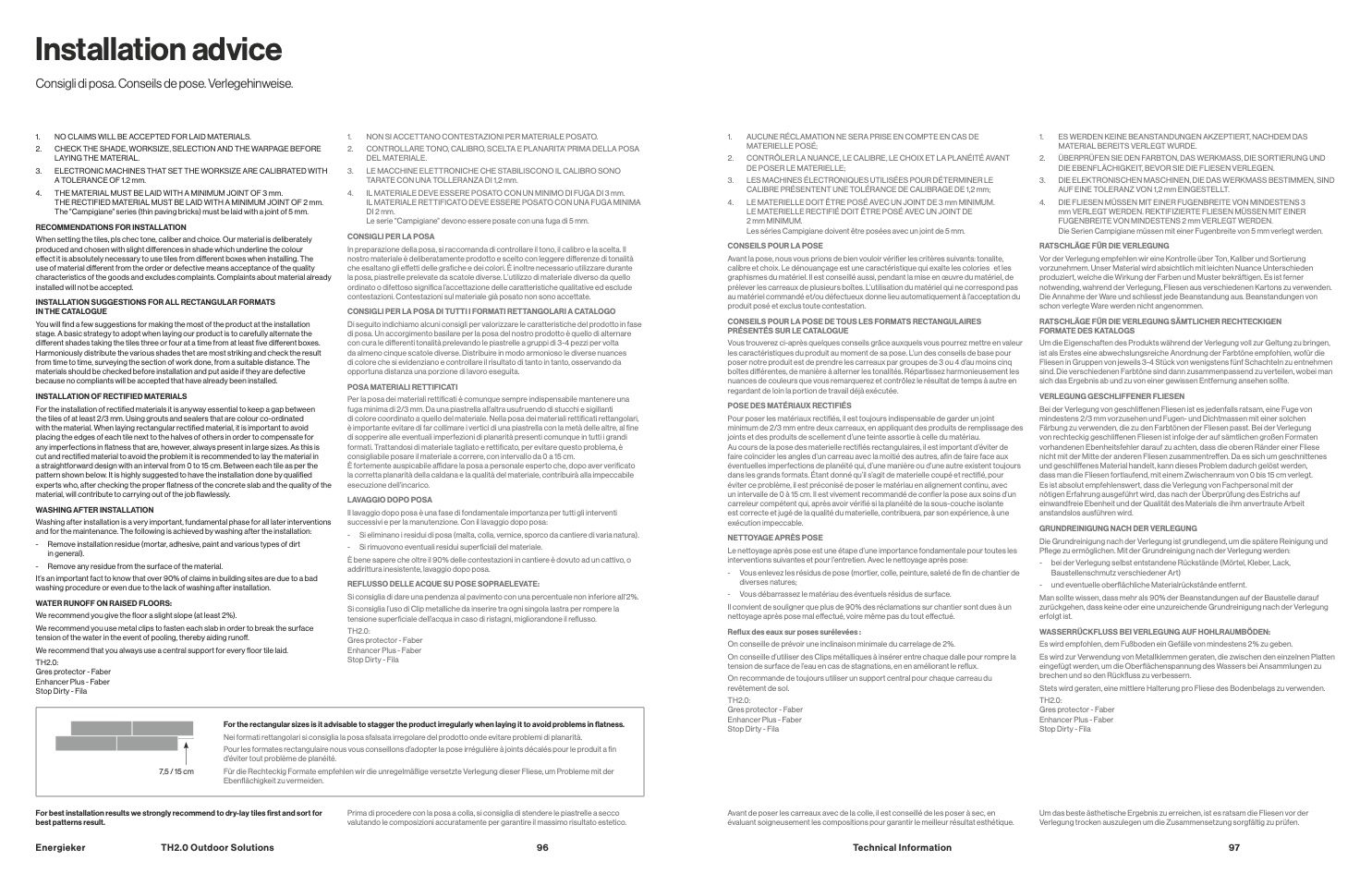
For the rectangular sizes is it advisable to stagger the product irregularly when laying it to avoid problems in flatness
.
Nei formati rettangolari si consiglia la posa sfalsata irregolare del prodotto onde evitare problemi di planarità.
Pour les formates rectangulaire nous vous conseillons d’adopter la pose irrégulière à joints décalés pour le produit a fi
n
d’éviter tout problème de planéité.
Für die Rechteckig Formate empfehlen wir die unregelmäßige versetzte Verlegung dieser Fliese, um Probleme mit der
Ebenflächigkeit zu vermeiden
.
For best installation results we strongly recommend to dry-lay tiles
first and sort for
best patterns result
.
Energieker
TH2.0 Outdoor Solutions
Prima di procedere con la posa a colla, si consiglia di stendere le piastrelle a secco
valutando le composizioni accuratamente per garantire il massimo risultato estetico.
9
6
1.
2.
3.
4.
AUCUNE RÉCLAMATION NE SERA PRISE EN COMPTE EN CAS DE
MATERIELLE POSÉ
;
CONTRÔLER LA NUANCE, LE CALIBRE, LE CHOIX ET LA PLANÉITÉ AVANT
DE POSER LE MATERIELLE
;
LES MACHINES ÉLECTRONIQUES UTILISÉES POUR DÉTERMINER LE
CALIBRE PRÉSENTENT UNE TOLÉRANCE DE CALIBRAGE DE 1,2 mm;
LE MATERIELLE DOIT ÊTRE POSÉ AVEC UN JOINT DE 3 mm MINIMUM.
LE MATERIELLE RECTIFIÉ DOIT ÊTRE POSÉ AVEC UN JOINT DE
2 mm MINIMUM
.
Les séries Campigiane doivent être posées avec un joint de 5 mm
.
CONSEILS POUR LA POS
E
Avant la pose, nous vous prions de bien vouloir vérifier les critères suivants: tonalite,
calibre et choix. Le dénouançage est une caractéristique qui exalte les colories
et le
s
graphismes du matériel. Il est conseillé aussi, pendant la mise en œuvre du matériel, de
prélever les carreaux de plusieurs boîtes. L’utilisation du matériel qui ne correspond pas
au matériel commandé et/ou défectueux donne lieu automatiquement à l’acceptation du
produit posé et exclus toute contestation
.
CONSEILS POUR LA POSE DE TOUS LES FORMATS RECTANGULAIRES
PRÉSENTÉS SUR LE CATALOGUE
Vous trouverez ci-après quelques conseils grâce auxquels vous pourrez mettre en valeur
les caractéristiques du produit au moment de sa pose. L’un des conseils de base pou
r
poser notre produit est de prendre les carreaux par groupes de 3 ou 4 d’au moins cin
q
boîtes différentes, de manière à alterner les tonalités. Répartissez harmonieusement le
s
nuances de couleurs que vous remarquerez et contrôlez le résultat de temps à autre en
regardant de loin la portion de travail déjà exécutée
.
POSE DES MATÉRIAUX RECTIFIÉS
Pour poser les matériaux rectifiés, il est toujours indispensable de garder un join
t
minimum de 2/3 mm entre deux carreaux, en appliquant des produits de remplissage des
joints et des produits de scellement d’une teinte assortie à celle du matériau.
Au cours de la pose des materielle recti
fiés rectangulaires, il est important d’éviter de
faire coïncider les angles d’un carreau avec la moitié des autres, afin de faire face aux
éventuelles imperfections de planéité qui, d’une manière ou d’une autre existent toujours
dans les grands formats. Étant donné qu’il s’agit de materielle coupé et rectifié, pour
éviter ce problème, il est préconisé de poser le matériau en alignement continu, avec
un intervalle de 0 à 15 cm. Il est vivement recommandé de con
fier la pose aux soins d’un
carreleur compétent qui, après avoir vérifié si la planéité de la sous-couche isolant
e
est correcte et jugé de la qualité du materielle, contribuera, par son expérience, à une
exécution impeccable
.
NETTOYAGE APRÈS POSE
Le nettoyage après pose est une étape d’une importance fondamentale pour toutes les
interventions suivantes et pour l’entretien. Avec le nettoyage après pose:
- Vous enlevez les résidus de pose (mortier, colle, peinture, saleté de fin de chantier d
e
diverses natures
;
- Vous débarrassez le matériau des éventuels résidus de surface.
Il convient de souligner que plus de 90% des réclamations sur chantier sont dues à un
nettoyage après pose mal effectué, voire même pas du tout e
ffectué.
Reflux des eaux sur poses surélevées :
On conseille de prévoir une inclinaison minimale du carrelage de 2%.
On conseille d’utiliser des Clips métalliques à insérer entre chaque dalle pour rompre l
a
tension de surface de l’eau en cas de stagnations, en en améliorant le re
flux.
On recommande de toujours utiliser un support central pour chaque carreau du
revêtement de sol.
TH2.0:
Gres protector - Faber
Enhancer Plus - Faber
Stop Dirty - Fila
Avant de poser les carreaux avec de la colle, il est conseillé de les poser à sec, e
n
évaluant soigneusement les compositions pour garantir le meilleur résultat esthétique.
Technical Informatio
n
1.
2.
3.
4.
ES WERDEN KEINE BEANSTANDUNGEN AKZEPTIERT, NACHDEM DAS
MATERIAL BEREITS VERLEGT WURDE.
ÜBERPRÜFEN SIE DEN FARBTON, DAS WERKMASS, DIE SORTIERUNG UND
DIE EBENFLÄCHIGKEIT, BEVOR SIE DIE FLIESEN VERLEGEN.
DIE ELEKTRONISCHEN MASCHINEN, DIE DAS WERKMASS BESTIMMEN, SIND
AUF EINE TOLERANZ VON 1,2 mm EINGESTELLT
.
DIE FLIESEN MÜSSEN MIT EINER FUGENBREITE VON MINDESTENS 3
mm VERLEGT WERDEN. REKTIFIZIERTE FLIESEN MÜSSEN MIT EINE
R
FUGENBREITE VON MINDESTENS 2 mm VERLEGT WERDEN.
Die Serien Campigiane müssen mit einer Fugenbreite von 5 mm verlegt werden.
RATSCHLÄGE FÜR DIE VERLEGUN
G
Vor der Verlegung empfehlen wir eine Kontrolle über Ton, Kaliber und Sortierun
g
vorzunehmem. Unser Material wird absichtlich mit leichten Nuance Unterschiede
n
produziert, welche die Wirkung der Farben und Muster bekräftigen. Es ist ferne
r
notwending, wahrend der Verlegung, Fliesen aus verschiedenen Kartons zu verwenden
.
Die Annahme der Ware und schliesst jede Beanstandung aus. Beanstandungen vo
n
schon verlegte Ware werden nicht angenommen.
RATSCHLÄGE FÜR DIE VERLEGUNG SÄMTLICHER RECHTECKIGE
N
FORMATE DES KATALOGS
Um die Eigenschaften des Produkts während der Verlegung voll zur Geltung zu bringen,
ist als Erstes eine abwechslungsreiche Anordnung der Farbtöne empfohlen, wofür di
e
Fliesen in Gruppen von jeweils 3-4 Stück von wenigstens fünf Schachteln zu entnehmen
sind. Die verschiedenen Farbtöne sind dann zusammenpassend zu verteilen, wobei ma
n
sich das Ergebnis ab und zu von einer gewissen Entfernung ansehen sollte.
VERLEGUNG GESCHLIFFENER FLIESE
N
Bei der Verlegung von geschli
ffenen Fliesen ist es jedenfalls ratsam, eine Fuge von
mindestens 2/3 mm vorzusehen und Fugen- und Dichtmassen mit einer solche
n
Färbung zu verwenden, die zu den Farbtönen der Fliesen passt. Bei der Verlegung
von rechteckig geschli
ffenen Fliesen ist infolge der auf sämtlichen großen Formaten
vorhandenen Ebenheitsfehler darauf zu achten, dass die oberen Ränder einer Flies
e
nicht mit der Mitte der anderen Fliesen zusammentreffen. Da es sich um geschnittenes
und geschli
ffenes Material handelt, kann dieses Problem dadurch gelöst werden,
dass man die Fliesen fortlaufend, mit einem Zwischenraum von 0 bis 15 cm verlegt
.
Es ist absolut empfehlenswert, dass die Verlegung von Fachpersonal mit de
r
nötigen Erfahrung ausgeführt wird, das nach der Überprüfung des Estrichs auf
einwandfreie Ebenheit und der Qualität des Materials die ihm anvertraute Arbei
t
anstandslos ausführen wird
.
GRUNDREINIGUNG NACH DER VERLEGUNG
Die Grundreinigung nach der Verlegung ist grundlegend, um die spätere Reinigung un
d
P
flege zu ermöglichen. Mit der Grundreinigung nach der Verlegung werden:
- bei der Verlegung selbst entstandene Rückstände (Mörtel, Kleber, Lack
,
Baustellenschmutz verschiedener Art
)
- und eventuelle ober
flächliche Materialrückstände entfernt
.
Man sollte wissen, dass mehr als 90% der Beanstandungen auf der Baustelle darau
f
zurückgehen, dass keine oder eine unzureichende Grundreinigung nach der Verlegun
g
erfolgt ist
.
WASSERRÜCKFLUSS BEI VERLEGUNG AUF HOHLRAUMBÖDEN
:
Es wird empfohlen, dem Fußboden ein Gefälle von mindestens 2% zu geben
.
Es wird zur Verwendung von Metallklemmen geraten, die zwischen den einzelnen Platte
n
eingefügt werden, um die Oberflächenspannung des Wassers bei Ansammlungen z
u
brechen und so den Rückfluss zu verbessern
.
Stets wird geraten, eine mittlere Halterung pro Fliese des Bodenbelags zu verwenden
.
TH2.0
:
Gres protector - Fabe
r
Enhancer Plus - Fabe
r
Stop Dirty - Fil
a
Um das beste ästhetische Ergebnis zu erreichen, ist es ratsam die Fliesen vor der
Verlegung trocken auszulegen um die Zusammensetzung sorgfältig zu prüfen
.
97

