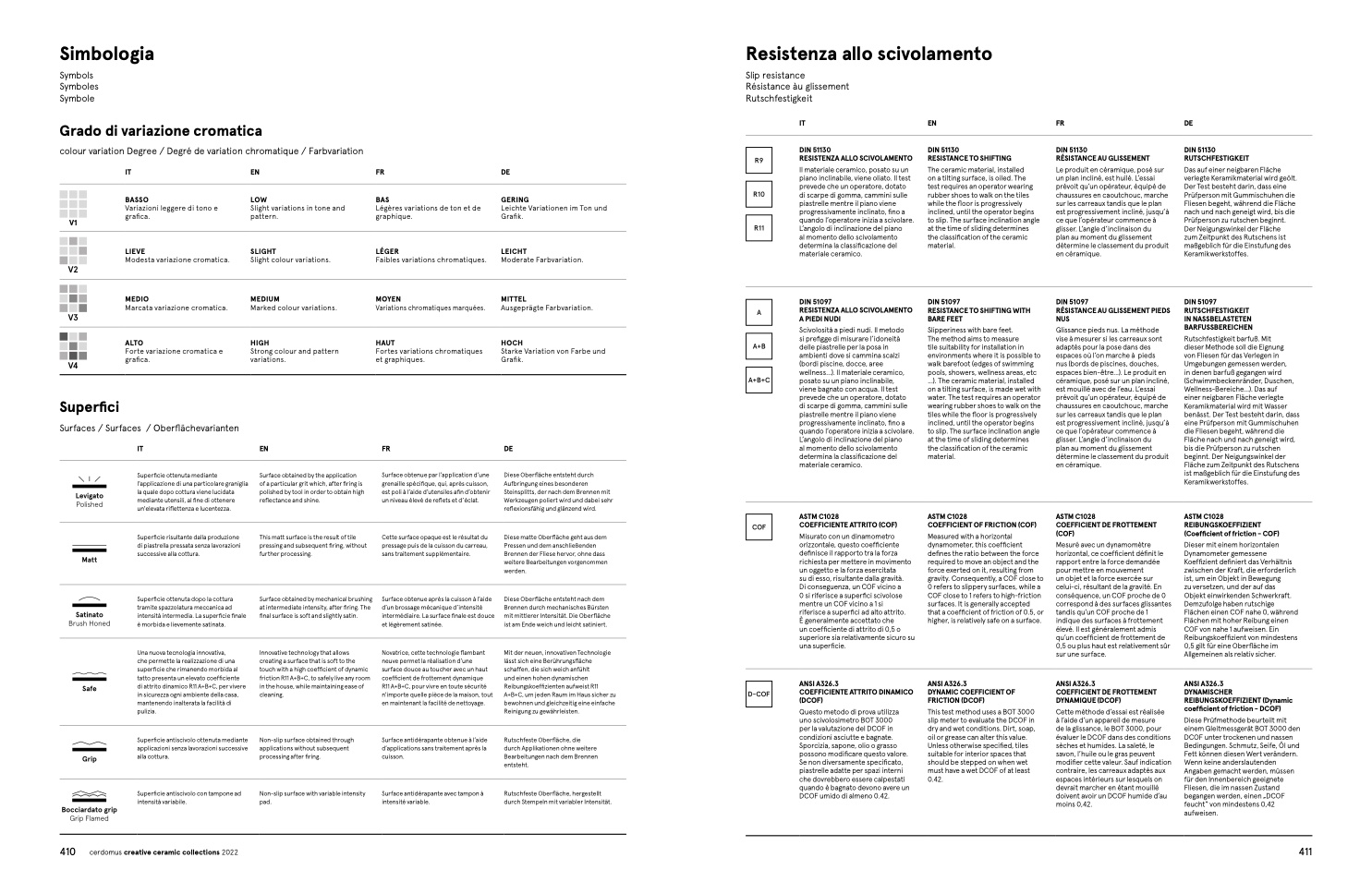
Simbologia
Symbols
Symboles
Symbole
Grado di variazione cromatica
colour variation Degree / Degré de variation chromatique / Farbvariation
Resistenza allo scivolamento
IT
BASSO
Variazioni leggere di tono e
grafica.
LIEVE
Modesta variazione cromatica.
MEDIO
Marcata variazione cromatica.
ALTO
Forte variazione cromatica e
grafica.
Surfaces / Surfaces / Oberflächevarianten
IT
Superficie ottenuta mediante
l'applicazione di una particolare graniglia
la quale dopo cottura viene lucidata
mediante utensili, al fine di ottenere
un'elevata riflettenza e lucentezza.
Superficie risultante dalla produzione
di piastrella pressata senza lavorazioni
successive alla cottura.
Superficie ottenuta dopo la cottura
tramite spazzolatura meccanica ad
intensità intermedia. La superficie finale
è morbida e lievemente satinata.
Una nuova tecnologia innovativa,
che permette la realizzazione di una
superficie che rimanendo morbida al
tatto presenta un elevato coefficiente
di attrito dinamico R11 A+B+C, per vivere
in sicurezza ogni ambiente della casa,
mantenendo inalterata la facilità di
pulizia.
Superficie antiscivolo ottenuta mediante
applicazioni senza lavorazioni successive
alla cottura.
Superficie antiscivolo con tampone ad
intensità variabile.
EN
LOW
Slight variations in tone and
pattern.
SLIGHT
Slight colour variations.
MEDIUM
Marked colour variations.
HIGH
Strong colour and pattern
variations.
EN
Surface obtained by the application
of a particular grit which, after firing is
polished by tool in order to obtain high
reflectance and shine.
This matt surface is the result of tile
pressing and subsequent firing, without
further processing.
Surface obtained by mechanical brushing
at intermediate intensity, after firing. The
final surface is soft and slightly satin.
Innovative technology that allows
creating a surface that is soft to the
touch with a high coefficient of dynamic
friction R11 A+B+C, to safely live any room
in the house, while maintaining ease of
cleaning.
Non-slip surface obtained through
applications without subsequent
processing after firing.
Non-slip surface with variable intensity
pad.
FR
BAS
Légères variations de ton et de
graphique.
LÉGER
Faibles variations chromatiques.
MOYEN
Variations chromatiques marquées.
HAUT
Fortes variations chromatiques
et graphiques.
FR
Surface obtenue par l’application d’une
grenaille spécifique, qui, après cuisson,
est poli à l’aide d’utensiles afin d’obtenir
un niveau élevé de reflets et d’éclat.
Cette surface opaque est le résultat du
pressage puis de la cuisson du carreau,
sans traitement supplémentaire.
Surface obtenue après la cuisson à l’aide
d’un brossage mécanique d’intensité
intermédiaire. La surface finale est douce
et légèrement satinée.
Novatrice, cette technologie flambant
neuve permet la réalisation d’une
surface douce au toucher avec un haut
coefficient de frottement dynamique
R11 A+B+C, pour vivre en toute sécurité
n'importe quelle pièce de la maison, tout
en maintenant la facilité de nettoyage.
Surface antidérapante obtenue à l’aide
d’applications sans traitement après la
cuisson.
Surface antidérapante avec tampon à
intensité variable.
DE
GERING
Leichte Variationen im Ton und
Grafik.
LEICHT
Moderate Farbvariation.
MITTEL
Ausgeprägte Farbvariation.
HOCH
Starke Variation von Farbe und
Grafik.
DE
Diese Oberfläche entsteht durch
Aufbringung eines besonderen
Steinsplitts, der nach dem Brennen mit
Werkzeugen poliert wird und dabei sehr
reflexionsfähig und glänzend wird.
Diese matte Oberfläche geht aus dem
Pressen und dem anschließenden
Brennen der Fliese hervor, ohne dass
weitere Bearbeitungen vorgenommen
werden.
Diese Oberfläche entsteht nach dem
Brennen durch mechanisches Bürsten
mit mittlerer Intensität. Die Oberfläche
ist am Ende weich und leicht satiniert.
Mit der neuen, innovativen Technologie
lässt sich eine Berührungsfläche
schaffen, die sich weich anfühlt
und einen hohen dynamischen
Reibungskoeffizienten aufweist R11
A+B+C, um jeden Raum im Haus sicher zu
bewohnen und gleichzeitig eine einfache
Reinigung zu gewährleisten.
Rutschfeste Oberfläche, die
durch Applikationen ohne weitere
Bearbeitungen nach dem Brennen
entsteht.
Rutschfeste Oberfläche, hergestellt
durch Stempeln mit variabler Intensität.
Slip resistance
Résistance àu glissement
Rutschfestigkeit
IT
DIN 51130
RESISTENZA ALLO SCIVOLAMENTO
Il materiale ceramico, posato su un
piano inclinabile, viene oliato. Il test
prevede che un operatore, dotato
di scarpe di gomma, cammini sulle
piastrelle mentre il piano viene
progressivamente inclinato, fino a
quando l’operatore inizia a scivolare.
L’angolo di inclinazione del piano
al momento dello scivolamento
determina la classificazione del
materiale ceramico.
DIN 51097
RESISTENZA ALLO SCIVOLAMENTO
A PIEDI NUDI
Scivolosità a piedi nudi. Il metodo
si prefigge di misurare l’idoneità
delle piastrelle per la posa in
ambienti dove si cammina scalzi
(bordi piscine, docce, aree
wellness...). Il materiale ceramico,
posato su un piano inclinabile,
viene bagnato con acqua. Il test
prevede che un operatore, dotato
di scarpe di gomma, cammini sulle
piastrelle mentre il piano viene
progressivamente inclinato, fino a
quando l’operatore inizia a scivolare.
L’angolo di inclinazione del piano
al momento dello scivolamento
determina la classificazione del
materiale ceramico.
ASTM C1028
COEFFICIENTE ATTRITO (COF)
Misurato con un dinamometro
orizzontale, questo coefficiente
definisce il rapporto tra la forza
richiesta per mettere in movimento
un oggetto e la forza esercitata
su di esso, risultante dalla gravità.
Di conseguenza, un COF vicino a
0 si riferisce a superfici scivolose
mentre un COF vicino a 1 si
riferisce a superfici ad alto attrito.
È generalmente accettato che
un coefficiente di attrito di 0,5 o
superiore sia relativamente sicuro su
una superficie.
ANSI A326.3
COEFFICIENTE ATTRITO DINAMICO
(DCOF)
Questo metodo di prova utilizza
uno scivolosimetro BOT 3000
per la valutazione del DCOF in
condizioni asciutte e bagnate.
Sporcizia, sapone, olio o grasso
possono modificare questo valore.
Se non diversamente specificato,
piastrelle adatte per spazi interni
che dovrebbero essere calpestati
quando è bagnato devono avere un
DCOF umido di almeno 0.42.
EN
DIN 51130
RESISTANCE TO SHIFTING
The ceramic material, installed
on a tilting surface, is oiled. The
test requires an operator wearing
rubber shoes to walk on the tiles
while the floor is progressively
inclined, until the operator begins
to slip. The surface inclination angle
at the time of sliding determines
the classification of the ceramic
material.
DIN 51097
RESISTANCE TO SHIFTING WITH
BARE FEET
Slipperiness with bare feet.
The method aims to measure
tile suitability for installation in
environments where it is possible to
walk barefoot (edges of swimming
pools, showers, wellness areas, etc
...). The ceramic material, installed
on a tilting surface, is made wet with
water. The test requires an operator
wearing rubber shoes to walk on the
tiles while the floor is progressively
inclined, until the operator begins
to slip. The surface inclination angle
at the time of sliding determines
the classification of the ceramic
material.
ASTM C1028
COEFFICIENT OF FRICTION (COF)
Measured with a horizontal
dynamometer, this coefficient
defines the ratio between the force
required to move an object and the
force exerted on it, resulting from
gravity. Consequently, a COF close to
0 refers to slippery surfaces, while a
COF close to 1 refers to high-friction
surfaces. It is generally accepted
that a coefficient of friction of 0.5, or
higher, is relatively safe on a surface.
ANSI A326.3
DYNAMIC COEFFICIENT OF
FRICTION (DCOF)
This test method uses a BOT 3000
slip meter to evaluate the DCOF in
dry and wet conditions. Dirt, soap,
oil or grease can alter this value.
Unless otherwise specified, tiles
suitable for interior spaces that
should be stepped on when wet
must have a wet DCOF of at least
0.42.
FR
DIN 51130
RÉSISTANCE AU GLISSEMENT
Le produit en céramique, posé sur
un plan incliné, est huilé. L’essai
prévoit qu’un opérateur, équipé de
chaussures en caoutchouc, marche
sur les carreaux tandis que le plan
est progressivement incliné, jusqu’à
ce que l’opérateur commence à
glisser. L’angle d’inclinaison du
plan au moment du glissement
détermine le classement du produit
en céramique.
DIN 51097
RÉSISTANCE AU GLISSEMENT PIEDS
NUS
Glissance pieds nus. La méthode
vise à mesurer si les carreaux sont
adaptés pour la pose dans des
espaces où l’on marche à pieds
nus (bords de piscines, douches,
espaces bien-être...). Le produit en
céramique, posé sur un plan incliné,
est mouillé avec de l’eau. L’essai
prévoit qu’un opérateur, équipé de
chaussures en caoutchouc, marche
sur les carreaux tandis que le plan
est progressivement incliné, jusqu’à
ce que l’opérateur commence à
glisser. L’angle d’inclinaison du
plan au moment du glissement
détermine le classement du produit
en céramique.
ASTM C1028
COEFFICIENT DE FROTTEMENT
(COF)
Mesuré avec un dynamomètre
horizontal, ce coefficient définit le
rapport entre la force demandée
pour mettre en mouvement
un objet et la force exercée sur
celui-ci, résultant de la gravité. En
conséquence, un COF proche de 0
correspond à des surfaces glissantes
tandis qu’un COF proche de 1
indique des surfaces à frottement
élevé. Il est généralement admis
qu’un coefficient de frottement de
0,5 ou plus haut est relativement sûr
sur une surface.
ANSI A326.3
COEFFICIENT DE FROTTEMENT
DYNAMIQUE (DCOF)
Cette méthode d’essai est réalisée
à l’aide d’un appareil de mesure
de la glissance, le BOT 3000, pour
évaluer le DCOF dans des conditions
sèches et humides. La saleté, le
savon, l’huile ou le gras peuvent
modifier cette valeur. Sauf indication
contraire, les carreaux adaptés aux
espaces intérieurs sur lesquels on
devrait marcher en étant mouillé
doivent avoir un DCOF humide d’au
moins 0,42.
DE
DIN 51130
RUTSCHFESTIGKEIT
Das auf einer neigbaren Fläche
verlegte Keramikmaterial wird geölt.
Der Test besteht darin, dass eine
Prüfperson mit Gummischuhen die
Fliesen begeht, während die Fläche
nach und nach geneigt wird, bis die
Prüfperson zu rutschen beginnt.
Der Neigungswinkel der Fläche
zum Zeitpunkt des Rutschens ist
maßgeblich für die Einstufung des
Keramikwerkstoffes.
DIN 51097
RUTSCHFESTIGKEIT
IN NASSBELASTETEN
BARFUSSBEREICHEN
Rutschfestigkeit barfuß. Mit
dieser Methode soll die Eignung
von Fliesen für das Verlegen in
Umgebungen gemessen werden,
in denen barfuß gegangen wird
(Schwimmbeckenränder, Duschen,
Wellness-Bereiche...). Das auf
einer neigbaren Fläche verlegte
Keramikmaterial wird mit Wasser
benässt. Der Test besteht darin, dass
eine Prüfperson mit Gummischuhen
die Fliesen begeht, während die
Fläche nach und nach geneigt wird,
bis die Prüfperson zu rutschen
beginnt. Der Neigungswinkel der
Fläche zum Zeitpunkt des Rutschens
ist maßgeblich für die Einstufung des
Keramikwerkstoffes.
ASTM C1028
REIBUNGSKOEFFIZIENT
(Coefficient of friction - COF)
Dieser mit einem horizontalen
Dynamometer gemessene
Koeffizient definiert das Verhältnis
zwischen der Kraft, die erforderlich
ist, um ein Objekt in Bewegung
zu versetzen, und der auf das
Objekt einwirkenden Schwerkraft.
Demzufolge haben rutschige
Flächen einen COF nahe 0, während
Flächen mit hoher Reibung einen
COF von nahe 1 aufweisen. Ein
Reibungskoeffizient von mindestens
0,5 gilt für eine Oberfläche im
Allgemeinen als relativ sicher.
ANSI A326.3
DYNAMISCHER
REIBUNGSKOEFFIZIENT (Dynamic
coefficient of friction - DCOF)
Diese Prüfmethode beurteilt mit
einem Gleitmessgerät BOT 3000 den
DCOF unter trockenen und nassen
Bedingungen. Schmutz, Seife, Öl und
Fett können diesen Wert verändern.
Wenn keine anderslautenden
Angaben gemacht werden, müssen
für den Innenbereich geeignete
Fliesen, die im nassen Zustand
begangen werden, einen „DCOF
feucht“ von mindestens 0,42
aufweisen.
V1
V2
V3
V4
Superfici
410
cerdomus creative ceramic collections 2022
411

