Installation and maintenance manual
Installation and Maintenance
360/361
For particular or aggressive stains we recommend the
use of specific detergents, but in any case it is
advisable to eliminate any stains quickly because
while the porcelain stoneware surface is practically
non-absorbent, the micro roughness that is present
on all tiles can make the cleaning more difficult, and
quick action normally allows for an immediate result.
In any case, the detergents indicated in table on page
338-339 can be used for lapped products, taking care
to avoid prolonged contact, respect the dilutions and
rinse. All the same, it is always best to test the product
beforehand on a tile that has not been laid or in a small
area of the floor.
EXTRAORDINARY MAINTENANCE
AND STAIN REMOVAL
Extraordinary maintenance is an operation to be
carried out only when there are stains or rings of
various kinds that cannot be eliminated with ordinary
routine maintenance.
These can be removed using a specific detergent in
the event of widespread dirt on the entire surface, or
for localised spots or residues it is possible to use a
stain remover. Removal occurs through a chemical
reaction between the stain and the detergent, so that,
depending on the nature of the dirt, it is necessary to
employ different types of products, as shown in table
on page 338-339.
DAILY CLEANING AND PERIODIC MAINTENANCE
The use of specific products for the daily cleaning of
porcelain stoneware contributes significantly to the
maintenance of its beauty and performance over time.
These solutions are used through traditional washing
systems (brush and rag or mop) and do not require
rinsing.
The products recommended for end-of-job cleaning
and ordinary or extraordinary cleaning are summarised
in table on page 338-339.
Introduction
The increasingly widespread use of porcelain
stoneware, distinguished by high technical and
aesthetic characteristics and intended for commercial
and residential environments, requires extra attention
during installation andcleaning to get the best results.
Modern porcelain stoneware tiles have adopted the
typical processes of stone products (rectifying,
lapping, polishing) leading to layouts with "minimal
joints".
The use of special pieces (strips, slats, waterjet cuts)
or the use of "multiple format" layouts complicates the
laying of floors.
REFIN therefore considers it useful to underline some
basic rules that apply to porcelain stoneware tiles.
Laying
First of all it is necessary to inspect the goods upon
receipt, checking:
- Correspondence between delivery documents and
goods.
- Colour, size, choice of material
- Presence of any defects
In this regard, remember that no claims will be
accepted for visible defects of already installed
tiles (see General Conditions of Sale on page 342)
REFIN porcelain stoneware tiles have a very low level
of water absorption (less than 0.2%) and it is therefore
necessary to use specific and high-quality glues, and
in any case traditional laying on concrete slabs is
strongly discouraged.
Therefore, use only improved adhesives having a
minimum class of C2 for the floor, C2 T for walls and
C2 S1-S2 for floors with heating screed, according to
EN 12004 which distinguishes the classes of
adhesives as shown below:
CHEMICAL NATURE:
- C = Cementitious adhesives
- D = Dispersion adhesives
- R = Reaction resin adhesives
ADHESIVE CLASS:
- 1 = Normal adhesive
- 2 = Improved adhesive
OPTIONAL CHARACTERISTICS:
- E = Extended open time
- F = Fast setting
- T = Reduced vertical slip
- S1 = Deformable cementitious adhesive
- S2 = Highly deformable cementitious adhesive
For porcelain stoneware, traditional laying with cement
mortar does not guarantee an adequate adhesion of
the tiles. Refin does not accept claims for material
laid without the use of suitable screed and
adhesives.
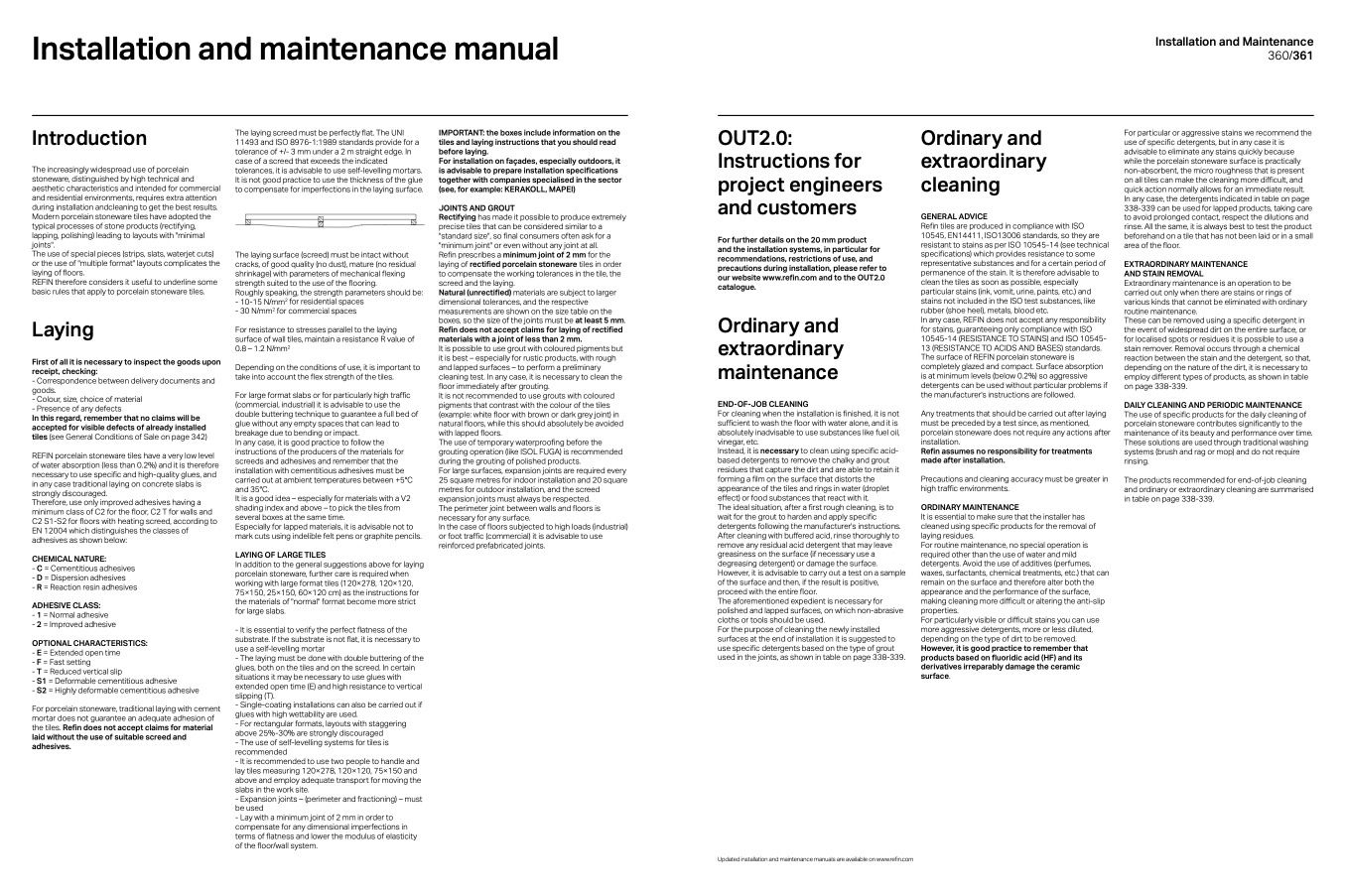
The laying screed must be perfectly flat. The UNI
11493 and ISO 8976-1:1989 standards provide for a
tolerance of +/- 3 mm under a 2 m straight edge. In
case of a screed that exceeds the indicated
tolerances, it is advisable to use self-levelling mortars.
It is not good practice to use the thickness of the glue
to compensate for imperfections in the laying surface.
The laying surface (screed) must be intact without
cracks, of good quality (no dust), mature (no residual
shrinkage) with parameters of mechanical flexing
strength suited to the use of the flooring.
Roughly speaking, the strength parameters should be:
- 10-15 N/mm
2
for residential spaces
- 30 N/mm
2
for commercial spaces
For resistance to stresses parallel to the laying
surface of wall tiles, maintain a resistance R value of
0.8 – 1.2 N/mm
2
Depending on the conditions of use, it is important to
take into account the flex strength of the tiles.
For large format slabs or for particularly high traffic
(commercial, industrial) it is advisable to use the
double buttering technique to guarantee a full bed of
glue without any empty spaces that can lead to
breakage due to bending or impact.
In any case, it is good practice to follow the
instructions of the producers of the materials for
screeds and adhesives and remember that the
installation with cementitious adhesives must be
carried out at ambient temperatures between +5°C
and 35°C.
It is a good idea – especially for materials with a V2
shading index and above – to pick the tiles from
several boxes at the same time.
Especially for lapped materials, it is advisable not to
mark cuts using indelible felt pens or graphite pencils.
LAYING OF LARGE TILES
In addition to the general suggestions above for laying
porcelain stoneware, further care is required when
working with large format tiles (120×278, 120×120,
75×150, 25×150, 60×120 cm) as the instructions for
the materials of "normal" format become more strict
for large slabs.
- It is essential to verify the perfect flatness of the
substrate. If the substrate is not flat, it is necessary to
use a self-levelling mortar
- The laying must be done with double buttering of the
glues, both on the tiles and on the screed. In certain
situations it may be necessary to use glues with
extended open time (E) and high resistance to vertical
slipping (T).
- Single-coating installations can also be carried out if
glues with high wettability are used.
- For rectangular formats, layouts with staggering
above 25%-30% are strongly discouraged
- The use of self-levelling systems for tiles is
recommended
- It is recommended to use two people to handle and
lay tiles measuring 120×278, 120×120, 75×150 and
above and employ adequate transport for moving the
slabs in the work site.
- Expansion joints – (perimeter and fractioning) – must
be used
- Lay with a minimum joint of 2 mm in order to
compensate for any dimensional imperfections in
terms of flatness and lower the modulus of elasticity
of the floor/wall system.
IMPORTANT: the boxes include information on the
tiles and laying instructions that you should read
before laying.
For installation on façades, especially outdoors, it
is advisable to prepare installation specifications
together with companies specialised in the sector
(see, for example: KERAKOLL, MAPEI)
JOINTS AND GROUT
Rectifying has made it possible to produce extremely
precise tiles that can be considered similar to a
"standard size", so final consumers often ask for a
"minimum joint" or even without any joint at all.
Refin prescribes a minimum joint of 2 mm for the
laying of rectified porcelain stoneware tiles in order
to compensate the working tolerances in the tile, the
screed and the laying.
Natural (unrectified) materials are subject to larger
dimensional tolerances, and the respective
measurements are shown on the size table on the
boxes, so the size of the joints must be at least 5 mm.
Refin does not accept claims for laying of rectified
materials with a joint of less than 2 mm.
It is possible to use grout with coloured pigments but
it is best – especially for rustic products, with rough
and lapped surfaces – to perform a preliminary
cleaning test. In any case, it is necessary to clean the
floor immediately after grouting.
It is not recommended to use grouts with coloured
pigments that contrast with the colour of the tiles
(example: white floor with brown or dark grey joint) in
natural floors, while this should absolutely be avoided
with lapped floors.
The use of temporary waterproofing before the
grouting operation (like ISOL FUGA) is recommended
during the grouting of polished products.
For large surfaces, expansion joints are required every
25 square metres for indoor installation and 20 square
metres for outdoor installation, and the screed
expansion joints must always be respected.
The perimeter joint between walls and floors is
necessary for any surface.
In the case of floors subjected to high loads (industrial)
or foot traffic (commercial) it is advisable to use
reinforced prefabricated joints.
OUT2.0:
Instructions for
project engineers
and customers
For further details on the 20 mm product
and the installation systems, in particular for
recommendations, restrictions of use, and
precautions during installation, please refer to
our website www.refin.com and to the OUT2.0
catalogue.
Ordinary and
extraordinary
maintenance
END-OF-JOB CLEANING
For cleaning when the installation is finished, it is not
sufficient to wash the floor with water alone, and it is
absolutely inadvisable to use substances like fuel oil,
vinegar, etc.
Instead, it is necessary to clean using specific acid-
based detergents to remove the chalky and grout
residues that capture the dirt and are able to retain it
forming a film on the surface that distorts the
appearance of the tiles and rings in water (droplet
effect) or food substances that react with it.
The ideal situation, after a first rough cleaning, is to
wait for the grout to harden and apply specific
detergents following the manufacturer's instructions.
After cleaning with buffered acid, rinse thoroughly to
remove any residual acid detergent that may leave
greasiness on the surface (if necessary use a
degreasing detergent) or damage the surface.
However, it is advisable to carry out a test on a sample
of the surface and then, if the result is positive,
proceed with the entire floor.
The aforementioned expedient is necessary for
polished and lapped surfaces, on which non-abrasive
cloths or tools should be used.
For the purpose of cleaning the newly installed
surfaces at the end of installation it is suggested to
use specific detergents based on the type of grout
used in the joints, as shown in table on page 338-339.
Ordinary and
extraordinary
cleaning
GENERAL ADVICE
Refin tiles are produced in compliance with ISO
10545, EN14411, ISO13006 standards, so they are
resistant to stains as per ISO 10545-14 (see technical
specifications) which provides resistance to some
representative substances and for a certain period of
permanence of the stain. It is therefore advisable to
clean the tiles as soon as possible, especially
particular stains (ink, vomit, urine, paints, etc.) and
stains not included in the ISO test substances, like
rubber (shoe heel), metals, blood etc.
In any case, REFIN does not accept any responsibility
for stains, guaranteeing only compliance with ISO
10545-14 (RESISTANCE TO STAINS) and ISO 10545-
13 (RESISTANCE TO ACIDS AND BASES) standards.
The surface of REFIN porcelain stoneware is
completely glazed and compact. Surface absorption
is at minimum levels (below 0.2%) so aggressive
detergents can be used without particular problems if
the manufacturer's instructions are followed.
Any treatments that should be carried out after laying
must be preceded by a test since, as mentioned,
porcelain stoneware does not require any actions after
installation.
Refin assumes no responsibility for treatments
made after installation.
Precautions and cleaning accuracy must be greater in
high traffic environments.
ORDINARY MAINTENANCE
It is essential to make sure that the installer has
cleaned using specific products for the removal of
laying residues.
For routine maintenance, no special operation is
required other than the use of water and mild
detergents. Avoid the use of additives (perfumes,
waxes, surfactants, chemical treatments, etc.) that can
remain on the surface and therefore alter both the
appearance and the performance of the surface,
making cleaning more difficult or altering the anti-slip
properties.
For particularly visible or difficult stains you can use
more aggressive detergents, more or less diluted,
depending on the type of dirt to be removed.
However, it is good practice to remember that
products based on fluoridic acid (HF) and its
derivatives irreparably damage the ceramic
surface.
Updated installation and maintenance manuals are available on www.refin.com

