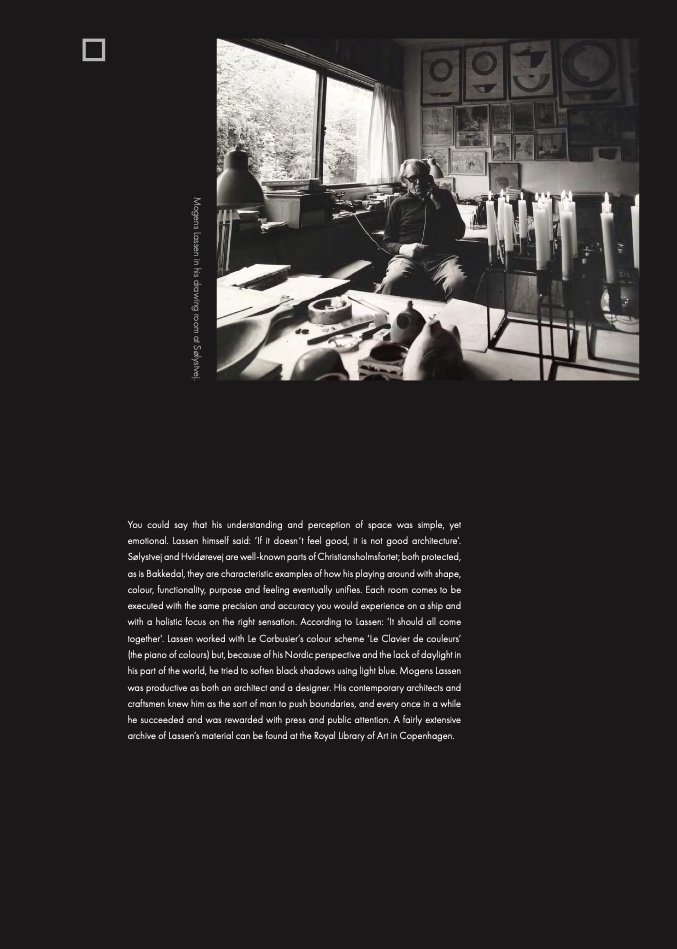
You could say that his understanding and perception of space was simple, yet
emotional. Lassen himself said: ‘If it doesn ́t feel good, it is not good architecture’.
Sølystvej and Hvidørevej are well-known parts of Christiansholmsfortet; both protected,
as is Bakkedal, they are characteristic examples of how his playing around with shape,
colour, functionality, purpose and feeling eventually unifies. Each room comes to be
executed with the same precision and accuracy you would experience on a ship and
with a holistic focus on the right sensation. According to Lassen: ‘It should all come
together’. Lassen worked with Le Corbusier’s colour scheme ‘Le Clavier de couleurs’
(the piano of colours) but, because of his Nordic perspective and the lack of daylight in
his part of the world, he tried to soften black shadows using light blue. Mogens Lassen
was productive as both an architect and a designer. His contemporary architects and
craftsmen knew him as the sort of man to push boundaries, and every once in a while
he succeeded and was rewarded with press and public attention. A fairly extensive
archive of Lassen’s material can be found at the Royal Library of Art in Copenhagen.
M
o
g
e
n
s
L
a
s
s
e
n
i
n
h
i
s
d
r
a
w
i
n
g
r
o
o
m
a
t
S
ø
l
y
s
t
v
e
j
.

