Flowmetering
Local regulations may restrict the use of this product to below the conditions quoted.
Flowmetering ancillaries
In the interests of development and improvement of the product, we reserve the right to change the specification without notice. © Copyright 2016
TI-P322-06
MI Issue 11
EL2270 and EL2271
Temperature Probes
Description
EL2270
The EL2270 is a Pt100 platinum resistance temperature sensor for general industrial use. The sensing device is an RTD 3 wire device
that meets EN 60751: Class A. This sensor can be connected directly to any temperature indicator or controller that has a 3 wire Pt100
input. A quick response version (40 mm insertion length only) is also available for applications such as plate heat exchanger control.
A miniature version of the EL2270 may also be ordered. This has a 1⁄4" BSP taper thread, and a tip length of 39 mm.
EL2271
The EL2271 is a combined Pt100 sensor and transmitter assembly. The sensing element is a 3 wire device that meets EN 60751:
Class A and the transmitter has a 4 - 20 mA output.
An ATEX approved version is available to special order.
A comprehensive standard range is normally available from stock. Non-standard ranges can be obtained to special order, subject to a
low limit of -50 °C, and a maximum of +500 °C. The 4 - 20 mA output can be connected directly to any temperature indicator, controller
or flow computer that has a 4 - 20 mA input. Contact Spirax Sarco for further details. Transmitters with 3 point calibration are available
to special order.
Pockets (thermowells)
General
Three types of pockets are available:
1. Thin wall with a 1⁄2" NPT process connection for non-flow applications only.
2. Drilled taper with a 1⁄2" NPT process connection.
3. Hygienic, to 3A sanitary standard, with a 11⁄2" sanitary clamp connection
(ASME BPE) electropolished to 0.4 μm (a Declaration of Conformity is
available).
Note: No pocket is available for the miniature EL2270.
Material
316 stainless steel
Maximum temperature
500 °C
Selection
Pockets are sized to suit the probe tip length 'D', and are specified as 'pocket to
suit a __ mm probe'.
Note 1 - The pocket dimension 'F' is 25 mm shorter than the probe length 'D',
which appears to be incorrect. The reason is that the threaded body of the pocket
acts as a stand-off, and therefore allows adequate clearance between the probe
tip and the end of the pocket.
Note 2 - Pockets to suit 225 mm and 725 mm probes are for non-flow
applications only (maximum flow velocity 0.65 m/sec).
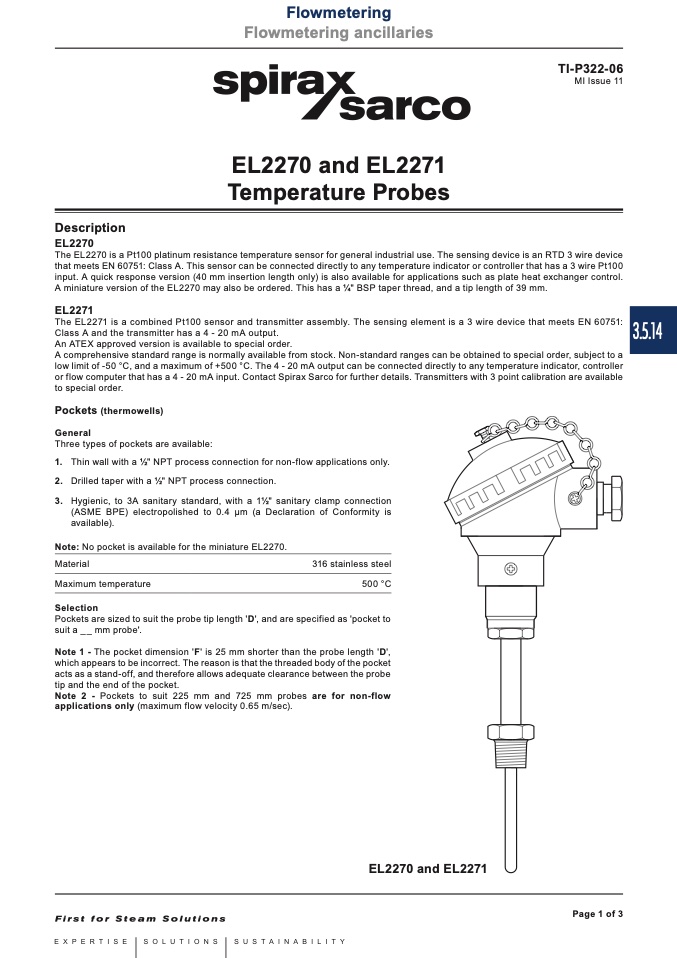
0 and EL2271
EL227
Page 1 of 3
3.5.14

