Pipeline ancillaries
Separators and insulation jackets
7.8.13
ISO 9001
TI-P023-39
ST Issue 3
Cert. No. LRQ 0963008
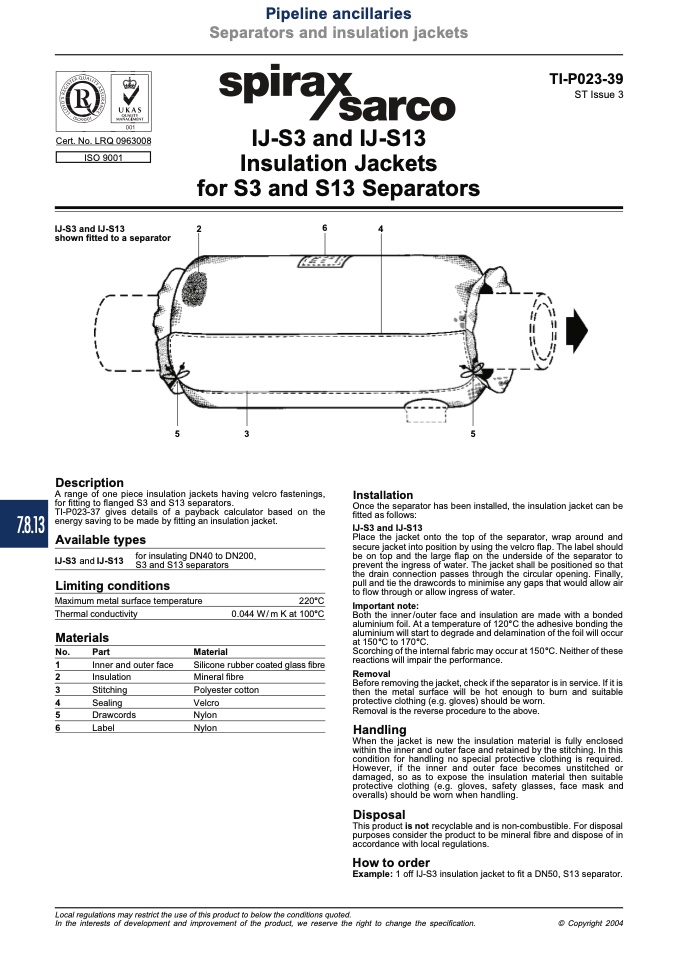
IJ-S3 and IJ-S13
shown fitted to a separator
IJ-S3 and IJ-S13
Insulation Jackets
for S3 and S13 Separators
2
6
4
5
3
5
Description
A range of one piece insulation jackets having velcro fastenings,
for fitting to flanged S3 and S13 separators.
TI-P023-37 gives details of a payback calculator based on the
energy saving to be made by fitting an insulation jacket.
Available types
Installation
IJ-S3 and IJ-S13
for insulating DN40 to DN200,
S3 and S13 separators
Once the separator has been installed, the insulation jacket can be
fitted as follows:
IJ-S3 and IJ-S13
Place the jacket onto the top of the separator, wrap around and
secure jacket into position by using the velcro flap. The label should
be on top and the large flap on the underside of the separator to
prevent the ingress of water. The jacket shall be positioned so that
the drain connection passes through the circular opening. Finally,
pull and tie the drawcords to minimise any gaps that would allow air
to flow through or allow ingress of water.
Both the inner/outer face and insulation are made with a bonded
aluminium foil. At a temperature of 120°C the adhesive bonding the
aluminium will start to degrade and delamination of the foil will occur
at 150°C to 170°C.
Removal
Before removing the jacket, check if the separator is in service. If it is
then the metal surface will be hot enough to burn and suitable
protective clothing (e.g. gloves) should be worn.
Removal is the reverse procedure to the above.
Handling
When the jacket is new the insulation material is fully enclosed
within the inner and outer face and retained by the stitching. In this
condition for handling no special protective clothing is required.
However, if the inner and outer face becomes unstitched or
damaged, so as to expose the insulation material then suitable
protective clothing (e.g. gloves, safety glasses, face mask and
overalls) should be worn when handling.
Disposal
This product is not recyclable and is non-combustible. For disposal
purposes consider the product to be mineral fibre and dispose of in
accordance with local regulations.
How to order
Example: 1 off IJ-S3 insulation jacket to fit a DN50, S13 separator.
Limiting conditions
Maximum metal surface temperature
Thermal conductivity
220°C
0.044 W / m K at 100°C
Important note:
Materials
No.
Part
1
Inner and outer face
2
Insulation
3
Stitching
4
Sealing
5
Drawcords
6
Label
Material
Scorching of the internal fabric may occur at 150°C. Neither of these
reactions will impair the performance.
Silicone rubber coated glass fibre
Mineral fibre
Polyester cotton
Velcro
Nylon
Nylon
Local regulations may restrict the use of this product to below the conditions quoted.
In the interests of development and improvement of the product, we reserve the right to change the specification.
© Copyright 2004

