Pipeline ancillaries
Strainers and filters
7.7.71
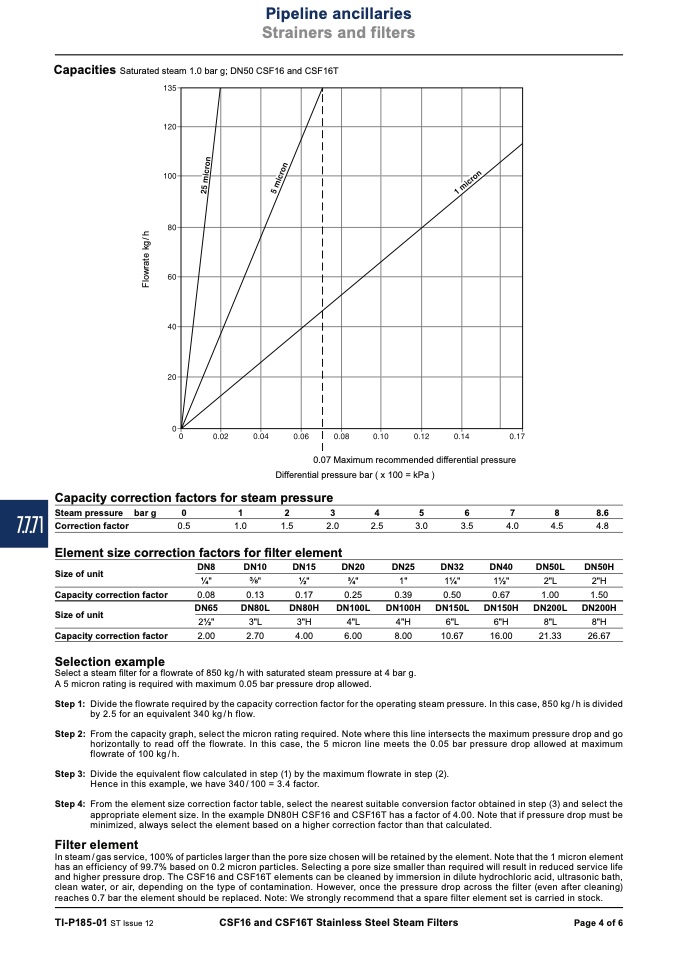
Capacities
Saturated steam 1.0 bar g; DN50 CSF16 and CSF16T
Capacity correction factors for steam pressure
Steam pressure bar g
0
1
2
3
Correction factor
0.5
1.0
1.5
2.0
Element size correction factors for filter element
4
2.5
5
3.0
6
7
8
8.6
3.5
4.0
4.5
4.8
0.07 Maximum recommended differential pressure
Differential pressure bar ( x 100 = kPa )
Size of unit
Capacity correction factor
Size of unit
Capacity correction factor
Selection example
DN25
DN32
DN40
DN50L
DN50H
DN8
DN10
DN15
DN20
1⁄4"
"
1⁄2"
3⁄4"
1"
11⁄4"
11⁄2"
2"L
2"H
0.08
0.13
DN65
DN80L
21⁄2"
3"L
2.00
2.70
0.17
0.25
0.39
DN80H
DN100L DN100H
3"H
4"L
4"H
4.00
6.00
8.00
0.50
0.67
DN150L DN150H
6"L
6"H
10.67
16.00
1.00
1.50
DN200L DN200H
8"L
8"H
21.33
26.67
Select a steam filter for a flowrate of 850 kg / h with saturated steam pressure at 4 bar g.
A 5 micron rating is required with maximum 0.05 bar pressure drop allowed.
Step 1: Divide the flowrate required by the capacity correction factor for the operating steam pressure. In this case, 850 kg / h is divided
by 2.5 for an equivalent 340 kg / h flow.
Step 2: From the capacity graph, select the micron rating required. Note where this line intersects the maximum pressure drop and go
horizontally to read off the flowrate. In this case, the 5 micron line meets the 0.05 bar pressure drop allowed at maximum
flowrate of 100 kg / h.
Step 3: Divide the equivalent flow calculated in step (1) by the maximum flowrate in step (2).
Hence in this example, we have 340 / 100 = 3.4 factor.
Step 4: From the element size correction factor table, select the nearest suitable conversion factor obtained in step (3) and select the
appropriate element size. In the example DN80H CSF16 and CSF16T has a factor of 4.00. Note that if pressure drop must be
minimized, always select the element based on a higher correction factor than that calculated.
Filter element
In steam / gas service, 100% of particles larger than the pore size chosen will be retained by the element. Note that the 1 micron element
has an efficiency of 99.7% based on 0.2 micron particles. Selecting a pore size smaller than required will result in reduced service life
and higher pressure drop. The CSF16 and CSF16T elements can be cleaned by immersion in dilute hydrochloric acid, ultrasonic bath,
clean water, or air, depending on the type of contamination. However, once the pressure drop across the filter (even after cleaning)
reaches 0.7 bar the element should be replaced. Note: We strongly recommend that a spare filter element set is carried in stock.
TI-P185-01 ST Issue 12
CSF16 and CSF16T Stainless Steel Steam Filters
Page 4 of 6
F
l
o
w
r
a
t
e
k
g
/
h

