Suggerimenti per posa e manutenzione
Advice for installation and care - Conseils pour la pose et l’entretien
Empfehlungen für die Verlegung und Pflege - Рекомендации по укладке и уходу
Introduzione - Introduction - Introduction - Vorbemerkung - Введение
Veri
fica del supporto e del materiale da posare
Checking the substrate and material to install - Contrôle du support et du matériel
à poser
Prüfung von Untergrund und Verlegematerial - Проверка основы и укладываемого материала
Un pavimento
è un sistema costituito da
pi
ù elementi, tra cui il materiale in grès
porcellanato, ed affinché il risultato di
posa sia soddisfacente
è necessario che il
massetto di sottofondo e l’installazione del
materiale ceramico vengano eseguiti “a
regola d’arte”. Come riferimento normativo
si consiglia di consultare la norma UNI 11493,
che regolamenta la posa di pavimenti e
rivestimenti interni ed esterni.
GB
A floor is a system made up of various
elements. In order to ensure satisfactory
installation, the screed must be made and
installation of the ceramic material performed in
accordance to the rules of the trade.
As reference, we recommend you to consult the
UNI 11493 standard that sets forth the rules for
installation of interior and exterior floor and wall
coverings.
F
Un carrelage est un syst
ème composé de
plusieurs
éléments dont le mat
ériel en grès
c
érame. Pour que le r
ésultat de la pose soit
satisfaisant, il faut que la chape, la sous-couche
et l’application du matériel c
éramique soient
effectués selon les règles de l’art.
À ce propos, il est conseill
é de consulter la
norme UNI 11493 qui r
églemente la pose de
carrelages et de rev
êtements intérieurs et
extérieurs.
D
Ein Fußboden ist ein System aus mehreren
Elementen, darunter das Feinsteinzeugmaterial.
F
ür ein zufriedenstellendes Verlegeresultat
m
üssen der darunterliegende Estrich sowie die
Verlegung des Keramikmaterials fachgerecht
ausgef
ührt werden.
Zur Normenlage siehe die Richtlinie UNI 11493
zur Verlegung von Wand- und Bodenbel
ägen in
Innen- und Außenbereichen.
RU
Пол - это система, состоящая из не-
скольких элементов, в том числе и из ке-
рамогранитного материала. Для получения
удовлетворительного результата укладки не-
обходимо безупречно залить подстилающую
стяжку и уложить керамический материал.
La veri
fica e la preparazione del supporto sono il
primo passo prima di iniziare la posa; controllare
che sia perfettamente planare, che non vi siano
fessurazioni, che sia ben pulito e scevro da polvere
e/o sostanze grasse. Un’altra veri
fica estremamen-
te importante
è il controllo del materiale da posare:
il posatore, prima della posa, essendo l’operatore
professionale che realizza la piastrellatura e che per
primo “vede” e “manipola” le piastrelle, deve veri
fi-
care che l’articolo sia quello scelto come colore e
formato, veri
ficare il tono, il calibro e la scelta e che
non vi siano piastrelle con vizi palesi e segnalare al
committente e al progettista eventuali anomalie.
Questa operazione di verifica deve sempre essere
fatta in quanto una volta posato il materiale viene
considerato accettato e quindi non pi
ù contestabi-
le. Ci possono essere casi in cui il massetto di sotto-
fondo sia costituito da un pavimento preesistente;
anche in questo caso bisogna avere delle accor-
tezze prima della posa del materiale ceramico in
modo da assicurarsi un lavoro realizzato ad opera
d’arte. La prima cosa da accertare
è che la pavi-
mentazione esistente sia perfettamente incollata
al sottofondo e sia priva di crepe; procedere quindi
con una profonda pulizia di sgrassaggio per elimi-
nare eventuali residui di cere o prodotti saponati
che utilizzati per lungo tempo potrebbero essersi
ancorati alla super
ficie. Tale pulizia deve essere ef-
fettuata con una soluzione di acqua e soda caustica
o tramite detergenti fortemente alcalini reperibili
in commercio. Se invece le condizioni del vecchio
pavimento non fossero soddisfacenti,
è necessario
rimuovere le piastrelle in fase di distacco, riempire
eventuali fessure del sottofondo tramite prodotti
speci
fici per quest’uso, colmare le zone in cui man-
cano le piastrelle tramite rasatura con cemento a
presa rapida; valutare insieme al committente e al
progettista l’utilizzo di un primer per una migliore
adesione al pavimento preesistente.
GB
Checking and preparing the substrate are the first
steps towards correct installation; make sure that the
substrate is perfectly flat, that there are no cracks, that
it is clean and that any dust and/or oily substances
have been removed. Another essential check is that
on the material to install: before installation, the fitter
in charge of laying, who actually “sees” the tiles and
possesses the necessary expertise to “handle” them,
must make sure that the item corresponds to your
choice in terms of colour and size; must check the
tone, the caliber and quality grade and make sure
that there are no visible faults. Such faults must be
immediately reported to the purchaser and project
engineer. This check must always be performed. After
installation, material is deemed to be accepted and
no complaint may be lodged. There may be cases in
which the substrate in an existing floor; this case also
calls for certain preliminary checks to be made before
installation so as to guarantee that work is performed
in accordance to the rules of the trade. First of all, make
sure the existing floor is perfectly and firmly attached
to underlying substrate and that there are no cracks;
clean thoroughly to remove grease, residues of wax
or soapy products that may have stuck to the surface.
This cleaning session must be performed using a
solution of water and caustic soda, or using strongly
alkaline detergents retrievable on the market. If the
conditions of the existing floor are not satisfactory,
dislodged tiles must be removed. Fill in the cracks
with products especially designed for this purpose
and gaps with quick-setting cement that must thus be
levelled accordingly. Before using a primer, consult the
purchaser and project engineer.
F
Il est nécessaire, avant la pose, de contr
ôler
et de pr
éparer le support ; de contrôler qu’il est
parfaitement plat, qu’il ne pr
ésente aucune fissure,
qu’il est bien propre, exempt de poussière et/ou
de substances grasses. Il est en outre extr
ême-
ment important de contrôler le matériel à poser :
le poseur,
à savoir l’opérateur professionnel qui
réalise le carrelage et qui « voit » et « manipule »
en premier les carreaux, doit s’assurer que l’article
correspond bien
à la couleur et au format choisis ;
que le ton et le calibre sont corrects et qu’aucun car-
reau ne présente de vices apparents. Il devra en outre
signaler toute anomalie au client et au designer. Cette
op
ération de contrôle est absolument nécessaire car,
une fois pos
é, le mat
ériel est considér
é comme étant
accept
é et il n’est plus possible de le contester. La
pose du matériel c
éramique sur une chape constituée
d’un vieux sol requiert elle aussi quelques contr
ôles de
mani
ère à l’ex
écuter dans les règles de l’art. Il faut avant
s’assurer que le vieux sol est parfaitement coll
é sur la
sous-couche et qu’il ne présente aucune fissure. Il faut
ensuite le d
égraisser pour éliminer tout résidu de cires
ou de produits savonneux qui pourraient, apr
ès avoir
ét
é longtemps utilisés, être accrochés
à la surface. Ce
nettoyage doit
être effectué avec une solution d’eau
et de soude caustique ou bien
à l’aide de d
étergents
fortement alcalins disponibles sur le march
é. Si les
conditions du vieux sol sont par contre douteuses,
enlever les carreaux durant la phase de décollement,
remplir les
éventuelles fissures de la sous-couche par
des produits spécialement pr
évus à cet effet, ragréer
les zones d
épourvues de carreaux avec du ciment
à
prise rapide. Il convient également d’évaluer avec le
client et le designer l’application d’une couche d’ap-
pr
êt pour améliorer l’adhérence au vieux sol.
D
Bevor mit der Verlegung selbst begonnen wird,
ist als erster Schritt der Untergrund zu prüfen und vor-
zubereiten. Dieser muss perfekt eben, frei von Rissen,
sauber und frei von Staub und/ oder fettigen Subs-
tanzen sein. Eine weitere, extrem wichtige Prüfung ist
jene des zu verlegenden Materials: Der Fliesenleger
hat als Experte, der die Fliesen vor der Verlegung als
Erster sieht und handhabt, die Aufgabe, diese zu kon-
trollieren. Es ist zu pr
üfen, ob Farbe und Format den
Wünschen entsprechen, außerdem Farbton, Kaliber
und Güteklasse, und dass keine angeschlagenen oder
anderweitig schadhaften Fliesen vorhanden sind.
Diese Kontrolle muss vor der Verlegung erfolgen, da
das Material nach der Verlegung als akzeptiert gilt
und nicht mehr beanstandet werden kann. In einigen
F
ällen erfolgt die Verlegung über einem vorhandenen
Bodenbelag; auch in diesem Fall sind vor der Ver-
legung des Keramikmaterials Kontrollen erforderlich,
um eine fachgerechtes Ergebnis zu erzielen. Zun
ächst
ist sicherzustellen, dass der vorhandene Bodenbelag
perfekt an seinem Untergrund anhaftet und keine
Risse aufweist. Anschließend ist er gr
ündlich zu rei-
nigen und zu entfetten, um eventuelle Spuren von
Wachs oder Seifen zu entfernen, die nach h
äufigem
Gebrauch noch an der Oberfl
äche anhaften k
önnten.
Diese Reinigung ist mit einer Lösung aus Wasser und
Ätznatron bzw. mit handels
üblichen, stark alkalischen
Produkten vorzunehmen. Ist der vorhandene Boden-
belag hingegen nicht in einwandfreiem Zustand, so
sind sich abl
ösende Fliesen zu entfernen, eventuelle
Risse im Untergrund mit Spezialprodukten zu f
üllen
und Stellen, in denen Fliesen fehlen, mit schnell ab-
bindendem Zement auszugleichen. Die Anwendung
eines Primers als Haftbr
ücke ist mit dem Bauherrn und
dem Planer zu erw
ägen.
RU
Проверка и подготовка основы - это пер-
вые операции, которые необходимо выполнить
перед началом укладки. Убедитесь, что основа
совершенно ровная, без трещин, совсем чистая
и без следов пыли и/или жирных веществ. Очень
важную роль играет также контроль укладыва-
емого материала: перед укладкой плиточник,
то есть, выполняющий работу мастер, которы
й
раньше всех видит плитку и обращается с ней,
должен проверить, что цвет и формат артику-
ла совпадают с выбранными, проверить тон,
калибр и сорт материала, а также убедиться в
отсутствии плитки с явными дефектами, сооб-
щая заказчику и проектировщику о возможных
проблемах. Следует обязательно выполнять эту
предварительную проверку, потому что после
укладки материал считается принятым заказчи-
ком, следовательно, претензии по нему не при-
нимаются. Бывает, что в качестве подстилающе-
го слоя используется уже существующий пол.
Также и в этом случае перед укладко
й керамиче-
ского материала необходимо соблюдать опре-
деленные меры предусмотрительности, чтобы
быть уверенными в качественном выполнении
работ. Прежде всего, следует убедиться в том,
что существующий пол прочно приклеен к под-
стилающему слою, и что отсутствуют трещины.
После этого необходимо выполнить тщательную
обезжиривающую очистку для удаления воз-
можных остатков воска или мылосодержащих
средств, которые в случае их длительного
использования могли пристать к поверхности.
Для выполнения такой очистки необходимо ис-
пользовать водный раствор каустической соды
или имеющиеся в продаже сильнощелочные
моющие средства. Если же состояние старого
пола неудовлетворительное, то необходимо уда-
лить отслоившуюся плитку, заполнить трещины
подстилающего слоя специально предназна-
ченными для этой цели продуктами, заполнить
и выровнить не облицованные плитко
й участки
быстросхватывающимся цементом. Обсудите
вместе с заказчиком и проектировщиком, це-
лесообразно ли использование грунтовки для
улучшения прилегания к существующему полу.
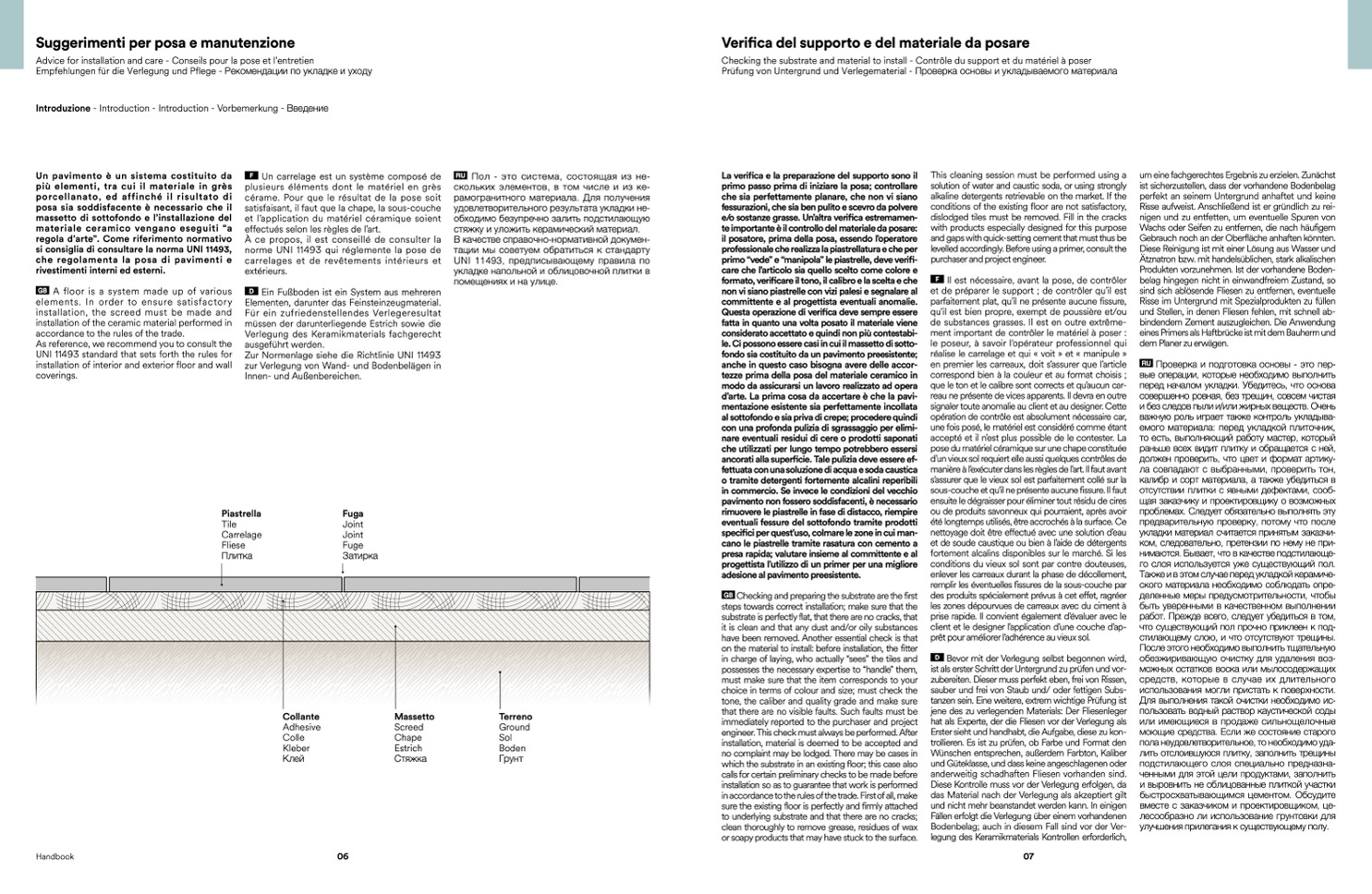
Piastrella
Tile
Carrelage
Fliese
Плитка
Fuga
Joint
Joint
Fuge
Затирка
В качестве справочно-нормативной докумен-
тации мы советуем обратиться к стандарту
UNI 11493, предписывающему правила по
укладке напольной и облицовочной плитки в
помещениях и на улице.
Collante
Massetto
Terreno
Adhesive
Screed
Ground
Handbook
06
07
Colle
Kleber
Кле
й
Chape
Estrich
Стяжка
Sol
Boden
Грунт

