Pulizia
finale dopo la posa in opera
Final cleaning after installation - Nettoyage curatif
Endreinigung nach der Verlegung - Конечная очистка после укладки
Dopo poche ore dalla stuccatura, non appena lo
stucco inizia ad asciugare (opacizzare), spazza-
re il pavimento.
• Entro 48 ore dalla stuccatura, e comunque
prima della completa maturazione e
dell’indurimento dello stucco, bagnare il
pavimento, con una soluzione acida ad
azione tamponata, con una percentuale di
diluizione variabile in funzione del tipo di
super
ficie (liscia o strutturata).
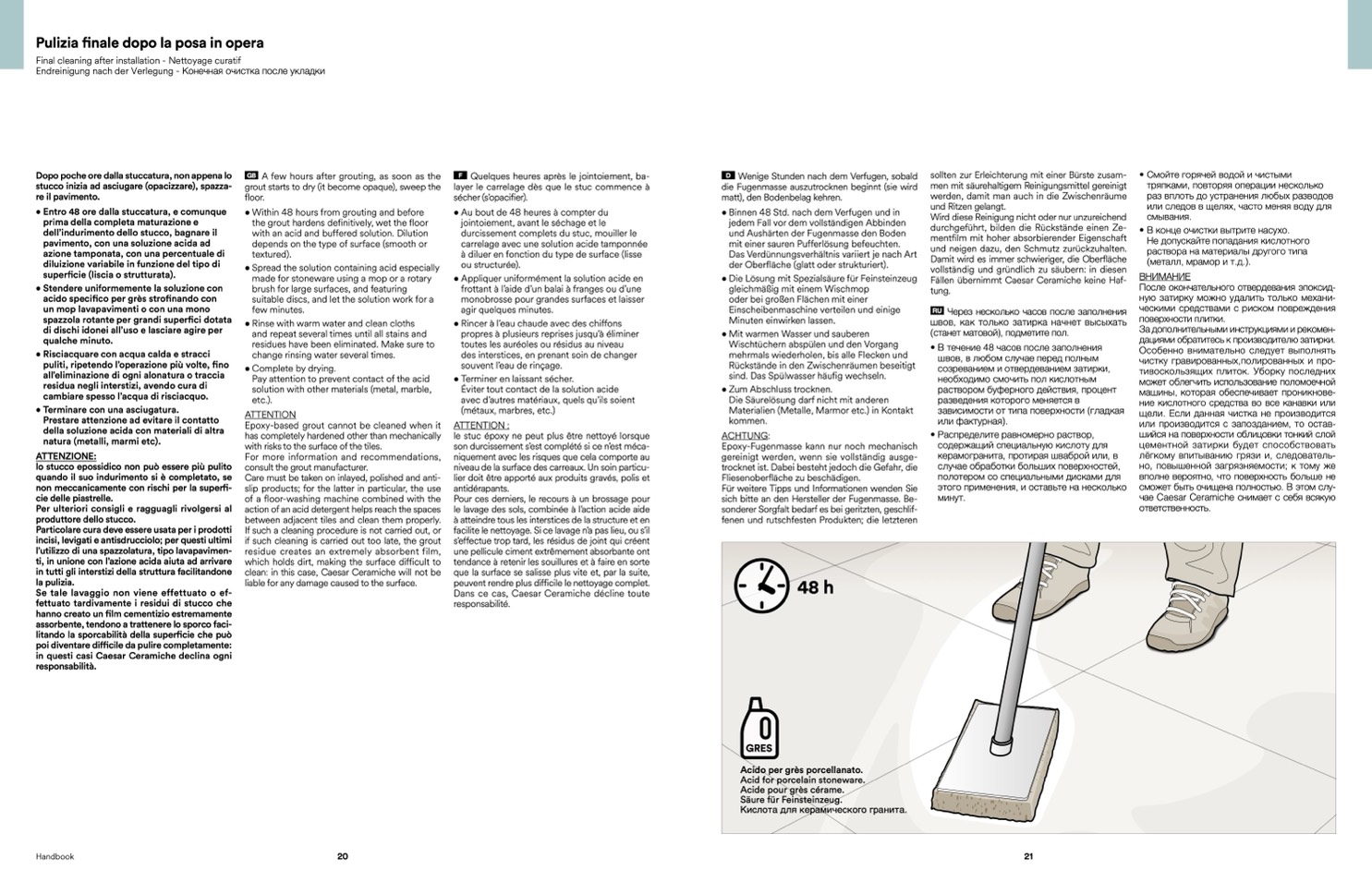
• Stendere uniformemente la soluzione con
acido speci
fico per gr
ès strofinando con
un mop lavapavimenti o con una mono
spazzola rotante per grandi superfici dotata
di dischi idonei all’uso e lasciare agire per
qualche minuto.
• Risciacquare con acqua calda e stracci
puliti, ripetendo l’operazione più volte,
fino
all’eliminazione di ogni alonatura o traccia
residua negli interstizi, avendo cura di
cambiare spesso l’acqua di risciacquo.
• Terminare con una asciugatura.
Prestare attenzione ad evitare il contatto
della soluzione acida con materiali di altra
natura (metalli, marmi etc).
ATTENZIONE:
lo stucco epossidico non può essere pi
ù pulito
quando il suo indurimento si è completato, se
non meccanicamente con rischi per la super
fi-
cie delle piastrelle.
Per ulteriori consigli e ragguagli rivolgersi al
produttore dello stucco.
Particolare cura deve essere usata per i prodotti
incisi, levigati e antisdrucciolo; per questi ultimi
l’utilizzo di una spazzolatura, tipo lavapavimen-
ti, in unione con l’azione acida aiuta ad arrivare
in tutti gli interstizi della struttura facilitandone
la pulizia.
Se tale lavaggio non viene effettuato o ef-
fettuato tardivamente i residui di stucco che
hanno creato un
film cementizio estremamente
assorbente, tendono a trattenere lo sporco faci-
litando la sporcabilità della super
ficie che può
poi diventare di
fficile da pulire completamente:
in questi casi Caesar Ceramiche declina ogni
responsabilit
à.
GB
A few hours after grouting, as soon as the
grout starts to dry (it become opaque), sweep the
floor.
• Within 48 hours from grouting and before
the grout hardens definitively, wet the floor
with an acid and buffered solution. Dilution
depends on the type of surface (smooth or
textured).
• Spread the solution containing acid especially
made for stoneware using a mop or a rotary
brush for large surfaces, and featuring
suitable discs, and let the solution work for a
few minutes.
• Rinse with warm water and clean cloths
and repeat several times until all stains and
residues have been eliminated. Make sure to
change rinsing water several times.
• Complete by drying.
Pay attention to prevent contact of the acid
solution with other materials (metal, marble,
etc.).
ATTENTION
Epoxy-based grout cannot be cleaned when it
has completely hardened other than mechanically
with risks to the surface of the tiles.
For more information and recommendations,
consult the grout manufacturer.
Care must be taken on inlayed, polished and anti-
slip products; for the latter in particular, the use
of a floor-washing machine combined with the
action of an acid detergent helps reach the spaces
between adjacent tiles and clean them properly.
If such a cleaning procedure is not carried out, or
if such cleaning is carried out too late, the grout
residue creates an extremely absorbent film,
which holds dirt, making the surface difficult to
clean: in this case, Caesar Ceramiche will not be
liable for any damage caused to the surface.
F
Quelques heures après le jointoiement, ba-
layer le carrelage d
ès que le stuc commence
à
s
écher (s’opacifier).
• Au bout de 48 heures
à compter du
jointoiement, avant le séchage et le
durcissement complets du stuc, mouiller le
carrelage avec une solution acide tamponn
ée
à diluer en fonction du type de surface (lisse
ou structurée).
• Appliquer uniform
ément la solution acide en
frottant à l’aide d’un balai à franges ou d’une
monobrosse pour grandes surfaces et laisser
agir quelques minutes.
• Rincer
à l’eau chaude avec des chiffons
propres à plusieurs reprises jusqu’
à
éliminer
toutes les aur
éoles ou résidus au niveau
des interstices, en prenant soin de changer
souvent l’eau de rinçage.
• Terminer en laissant sécher.
Éviter tout contact de la solution acide
avec d’autres matériaux, quels qu’ils soient
(métaux, marbres, etc.)
ATTENTION :
le stuc
époxy ne peut plus être nettoyé lorsque
son durcissement s’est compl
ét
é si ce n’est méca-
niquement avec les risques que cela comporte au
niveau de la surface des carreaux. Un soin particu-
lier doit
être apporté aux produits grav
és, polis et
antid
érapants.
Pour ces derniers, le recours
à un brossage pour
le lavage des sols, combin
ée
à l’action acide aide
à atteindre tous les interstices de la structure et en
facilite le nettoyage. Si ce lavage n’a pas lieu, ou s’il
s’effectue trop tard, les résidus de joint qui cr
éent
une pellicule ciment extr
êmement absorbante ont
tendance
à retenir les souillures et à faire en sorte
que la surface se salisse plus vite et, par la suite,
peuvent rendre plus difficile le nettoyage complet.
Dans ce cas, Caesar Ceramiche d
écline toute
responsabilit
é.
D
Wenige Stunden nach dem Verfugen, sobald
die Fugenmasse auszutrocknen beginnt (sie wird
matt), den Bodenbelag kehren.
• Binnen 48 Std. nach dem Verfugen und in
jedem Fall vor dem vollst
ändigen Abbinden
und Aush
ärten der Fugenmasse den Boden
mit einer sauren Pufferlösung befeuchten.
Das Verd
ünnungsverhältnis variiert je nach Art
der Oberfläche (glatt oder strukturiert).
• Die Lösung mit Spezialsäure für Feinsteinzeug
gleichm
äßig mit einem Wischmop
oder bei großen Flächen mit einer
Einscheibenmaschine verteilen und einige
Minuten einwirken lassen.
• Mit warmen Wasser und sauberen
Wischt
üchern abspülen und den Vorgang
mehrmals wiederholen, bis alle Flecken und
R
ückstände in den Zwischenr
äumen beseitigt
sind. Das Spülwasser h
äufig wechseln.
• Zum Abschluss trocknen.
Die Säurelösung darf nicht mit anderen
Materialien (Metalle, Marmor etc.) in Kontakt
kommen.
ACHTUNG:
Epoxy-Fugenmasse kann nur noch mechanisch
gereinigt werden, wenn sie vollständig ausge-
trocknet ist. Dabei besteht jedoch die Gefahr, die
Fliesenoberfläche zu beschädigen.
Für weitere Tipps und Informationen wenden Sie
sich bitte an den Hersteller der Fugenmasse. Be-
sonderer Sorgfalt bedarf es bei geritzten, geschlif-
fenen und rutschfesten Produkten; die letzteren
sollten zur Erleichterung mit einer B
ürste zusam-
men mit s
äurehaltigem Reinigungsmittel gereinigt
werden, damit man auch in die Zwischenräume
und Ritzen gelangt.
Wird diese Reinigung nicht oder nur unzureichend
durchgef
ührt, bilden die R
ückst
ände einen Ze-
mentfilm mit hoher absorbierender Eigenschaft
und neigen dazu, den Schmutz zur
ückzuhalten.
Damit wird es immer schwieriger, die Oberfl
äche
vollst
ändig und gr
ündlich zu säubern: in diesen
F
ällen übernimmt Caesar Ceramiche keine Haf-
tung.
RU
Через несколько часов после заполнения
швов, как только затирка начнет высыхать
(станет матовой), подметите пол.
• Смо
йте горячей водой и чистыми
тряпками, повторяя операции несколько
раз вплоть до устранения любых разводов
или следов в щелях, часто меняя воду для
смывания.
• В конце очистки вытрите насухо.
Не допуска
йте попадания кислотного
раствора на материалы другого типа
(металл, мрамор и т.д.).
ВНИМАНИЕ
После окончательного отвердевания эпоксид-
ную затирку можно удалить только механи-
ческими средствами с риском повреждения
поверхности плитки.
За дополнительными инструкциями и рекомен-
дациями обратитесь к производителю затирки.
Особенно внимательно следует выполнять
чистку гравированных,полированных и про-
тивоскользящих плиток. Уборку последних
может облегчить использование поломоечно
й
машины, которая обеспечивает проникнове-
ние кислотного средства во все канавки или
щели. Если данная чистка не производится
или производится с запозданием, то остав-
шийся на поверхности облицовки тонки
й сло
й
цементной затирки будет способствовать
лёгкому впитыванию грязи и, следователь-
но, повышенной загрязняемости; к тому же
вполне вероятно, что поверхность больше не
сможет быть очищена полностью. В этом слу-
чае Caesar Ceramiche снимает с себя всякую
ответственность.
•
•
В течение 48 часов после заполнения
швов, в любом случае перед полным
созреванием и отвердеванием затирки,
необходимо смочить пол кислотным
раствором буферного действия, процент
разведения которого меняется в
зависимости от типа поверхности (гладкая
или фактурная).
Распределите равномерно раствор,
содержащий специальную кислоту для
керамогранита, протирая шваброй или, в
случае обработки больших поверхностей,
полотером со специальными дисками для
этого применения, и оставьте на несколько
минут.
48h
GRES
Acido per gr
ès porcellanato.
Acid for porcelain stoneware.
Acide pour grès c
érame.
S
äure f
ür Feinsteinzeug.
Кислота для керамического гранита.
Handbook
20
21

