3 .
U N I T
I N S T A L L A T I O N
Before installation, be sure to confirm the model name and serial number of the unit.
3.1 INSTALLATION SITE REQUIREMENTS
The choice of installation site must be determined by the system designer or by qualified personnel an
d
must take into account the technical requirements and current local Regulations
.
In addition, the following conditions and factors must also be taken into account
:
• The unit is designed for indoor installation, do not install it outdoors
;
• Locations where maintenance space can be guaranteed;
• Ventilated locations;
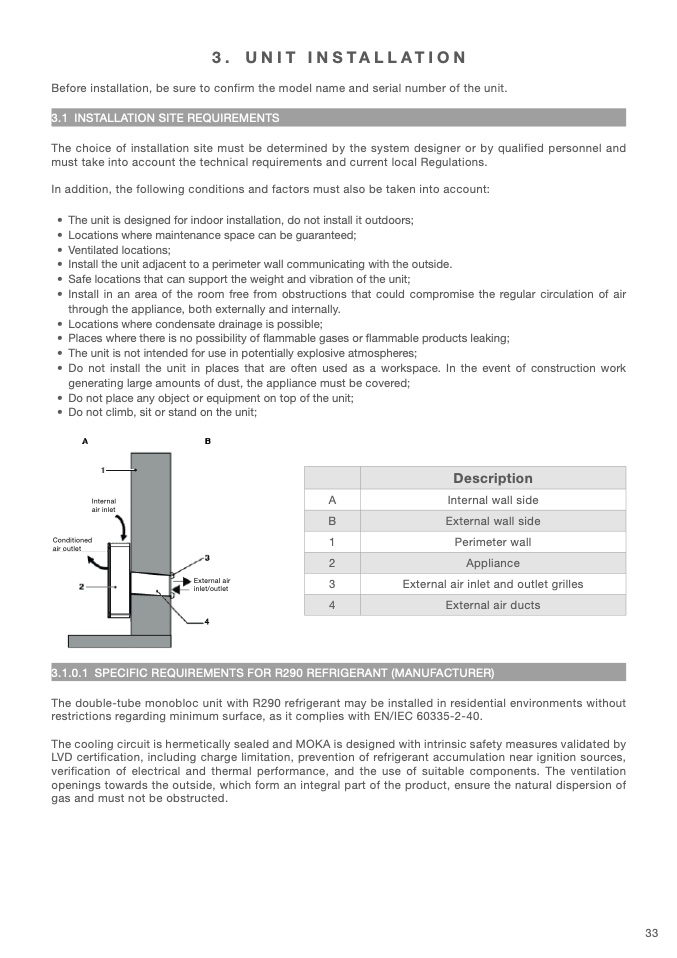
• Install the unit adjacent to a perimeter wall communicating with the outside
.
• Safe locations that can support the weight and vibration of the unit
;
• Install in an area of the room free from obstructions that could compromise the regular circulation of ai
r
through the appliance, both externally and internally
.
• Locations where condensate drainage is possible;
• Places where there is no possibility of fl ammable gases or
fl ammable products leaking
;
• The unit is not intended for use in potentially explosive atmospheres
;
• Do not install the unit in places that are often used as a workspace. In the event of construction wor
k
generating large amounts of dust, the appliance must be covered;
• Do not place any object or equipment on top of the unit
;
• Do not climb, sit or stand on the unit
;
Descriptio
n
Interna
l
air inle
t
A
Internal wall side
B
External wall sid
e
Conditioned
air outle
t
1
Perimeter wall
2
Applianc
e
External air
inlet/outle
t
3
External air inlet and outlet grille
s
4
External air ducts
3.1.0.1 SPECIFIC REQUIREMENTS FOR R290 REFRIGERANT (MANUFACTURER
)
The double-tube monobloc unit with R290 refrigerant may be installed in residential environments withou
t
restrictions regarding minimum surface, as it complies with EN/IEC 60335-2-40.
The cooling circuit is hermetically sealed and MOKA is designed with intrinsic safety measures validated b
y
LVD certification, including charge limitation, prevention of refrigerant accumulation near ignition sources,
verification of electrical and thermal performance, and the use of suitable components. The ventilatio
n
openings towards the outside, which form an integral part of the product, ensure the natural dispersion of
gas and must not be obstructed.
33

