HYBALANS+
Perchè è nata la ventilazione meccanica controllata (VMC)?
Why was the mechanical ventilation system (MVS) born?
1. La Ventilazione Meccanica Controllata è una tecnologia impiantistica nata nel
momento in cui si cominciò a costruire abitazioni che consumassero meno
energia per essere scaldate. Con l’introduzione di materiali isolanti nelle pareti
e l’installazione di serramenti a tenuta stagna, si raggiungeva il considerevole
obiettivo della riduzione dei fabbisogni energetici, andando tuttavia a in
fluire
negativamente sulla salubrità dell’aria interna. In questo modo, venendo
a mancare il ricambio dell’aria all’interno dell’abitazione e la necessaria
estrazione degli elementi inquinanti domestici, si creavano problemi di
condensa, muffe, ristagno di odori e vapori di cottura. Aprire le finestre di
casa per assicurare il ricambio d’aria poteva risultare estremamente scomodo
e con inutili sprechi di energia. Si pensò quindi ad un ricambio d’aria
“forzato” che fosse sempre in funzione 24 ore su 24 e per tutto l’arco dell’anno
e che andasse a sostituire l’apertura manuale delle finestre con una differenza
fondamentale: la possibilità di controllare esattamente le portate, limitando
al minimo indispensabile il ricambio dell’aria e quindi gli sprechi di energia,
impossibile con le aperture manuali delle finestre. Entro il 2020 tutti gli edifici
di nuova costruzione dovranno essere a “impatto zero”, di conseguenza non si
potrà fare a meno di questa nuova tecnologia.
The Mechanical Ventilation System is an installation
technology that became necessary with the
construction of low energy houses. By insulating the
walls and installing airtight window frames, you could
considerably reduce the energy needs, though
negatively affecting the healthiness of the indoor air.
The lack of indoor air change and of dirty air extraction
caused condensation problems, molds, stagnation
of smells and cooking vapors. Opening the windows
of the house to ensure a proper air change could be
extremely inconvenient, causing wastes of energy.
Therefore, they designed a “forced” air exchange
system operating 24H a day and throughout the year
that could avoid the manual opening of the windows,
allowing a total airflow control and limiting the air
change and therefore the wastes of energy to a
minimum, which was previously impossible. All new
buildings will have to be “zero impact” and, therefore,
this new technology will be indispensable.
Come funziona la ventilazione meccanica controllata?
How does the mechanical ventilation work?
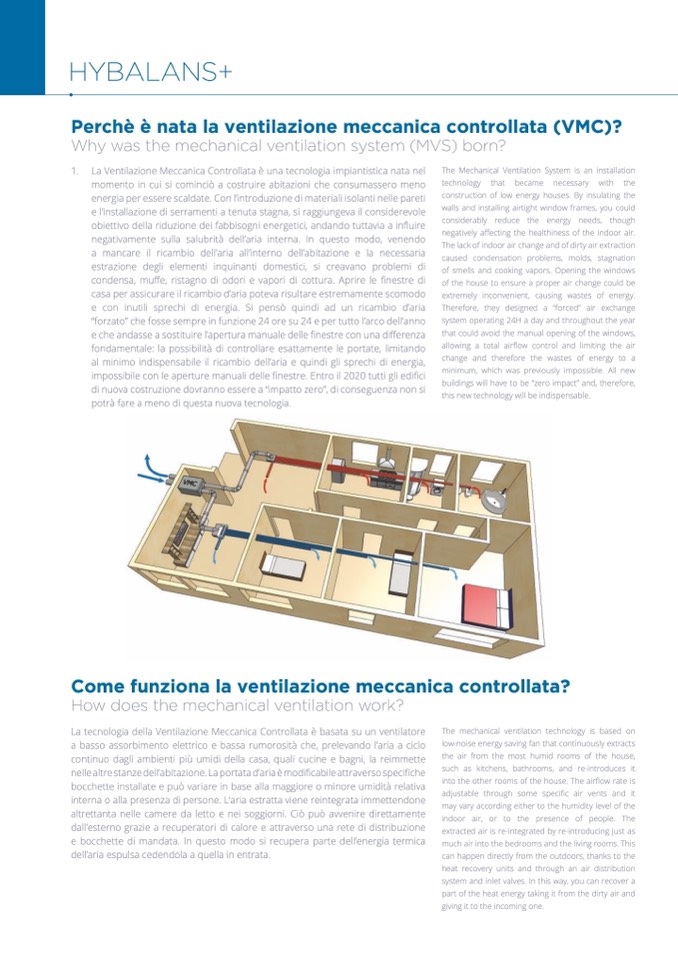
La tecnologia della Ventilazione Meccanica Controllata è basata su un ventilatore
a basso assorbimento elettrico e bassa rumorosità che, prelevando l’aria a ciclo
continuo dagli ambienti più umidi della casa, quali cucine e bagni, la reimmette
nelle altre stanze dell’abitazione. La portata d’aria è modificabile attraverso specifiche
bocchette installate e può variare in base alla maggiore o minore umidità relativa
interna o alla presenza di persone. L’aria estratta viene reintegrata immettendone
altrettanta nelle camere da letto e nei soggiorni. Ciò può avvenire direttamente
dall’esterno grazie a recuperatori di calore e attraverso una rete di distribuzione
e bocchette di mandata. In questo modo si recupera parte dell’energia termica
dell’aria espulsa cedendola a quella in entrata.
The mechanical ventilation technology is based on
low-noise energy saving fan that continuously extracts
the air from the most humid rooms of the house,
such as kitchens, bathrooms, and re-introduces it
into the other rooms of the house. The airflow rate is
adjustable through some specific air vents and it
may vary according either to the humidity level of the
indoor air, or to the presence of people. The
extracted air is re-integrated by re-introducing just as
much air into the bedrooms and the living rooms. This
can happen directly from the outdoors, thanks to the
heat recovery units and through an air distribution
system and inlet valves. In this way, you can recover a
part of the heat energy taking it from the dirty air and
giving it to the incoming one.

