COMPATT
A
CEDIT: le ceramiche d’Italia che hanno fatto storia | CEDIT: Italian ceramic tiles that have shaped history
genuinely innovative designs by leading modern designers, responding to and
shaping the needs and taste of the period. It was the
first time a ceramic wall til
e
manufacturer had set out to interpret the “year’s fashions”, by suggesting functional,
decorative home design solutions styled by artists of the calibre of Enzo Mari, Ettor
e
Sottsass, Bob Noorda, Michele Provinciali, Joshitaka Sakuma, Bruno Binosi, Carme
n
Grusova-Rihova, Gilio Confalonieri, Franca Helg & Antonio Piva, Ferruccio Bocca,
Sergio Asti and Marco Zanuso.
The result was “Collezione 68”, a one-off in the history of ceramic coverings that
was to usher in a new era in the industry. The major change was in the versatility
of wall covering design, breaking away from repetitiveness, with the potential fo
r
building up a variety of compositional themes from a single motif; amongst other
results, this development helped to make geometric design and product graphics an
essential phase in the industrial production of ceramic materials
.
CEDIT’s ground-breaking work continued in 1970 with another key project
:
the “16 giochi a parete” [“16 wall games”] exhibition hosted at the company’s Mila
n
showroom, at Via Verri 4, which invited visitors to reflect on new possible perceptions
of ceramic-clad surfaces, viewing the wall as a “chessboard” to be built up using
a
wide variety of combinations
.
This eclectic and very popular exhibition contained ideas by a select group o
f
creative talents - designers, graphic designers and artists - including Sergio Asti
,
Bruno Binosi, Severina Corbetta and Maria Grazia Caccini, Jean-Pierre Garrault
,
Salvatore Gregorietti, Gino Marotta, Franco Mirenzi, Pietro Monti and Giuli
o
Buonpane, Bob Noorda, Ornella Noorda, Pietro Salmoiraghi and Antonio Locatelli
,
each of which visitors could use to “invent” di
fferent possible combinations. CEDIT
launched a manifesto for a new approach to the traditional, static concept of the wal
l
with decorative cladding: ceramic tiles were used like fabrics or movable items whic
h
could be
fitted and removed exactly as preferred, in response to the visitor’s curren
t
taste or instinct for play
.
This exhibition project reinforced the company’s conviction that partnerships
with creative talents could be a successful strategy for continual promotion of the
product’s market visibility. In the past as in the present, what CEDIT asks artists
,
graphic designers, architects and stylists to do has always been the same, and thi
s
project urged them to view the walls of the home as imaginary surfaces, empt
y
sheets on which they could express a revolutionary idea of design freedom and styl
e
a vibrant interior in tune with person who lived there and his or her needs.
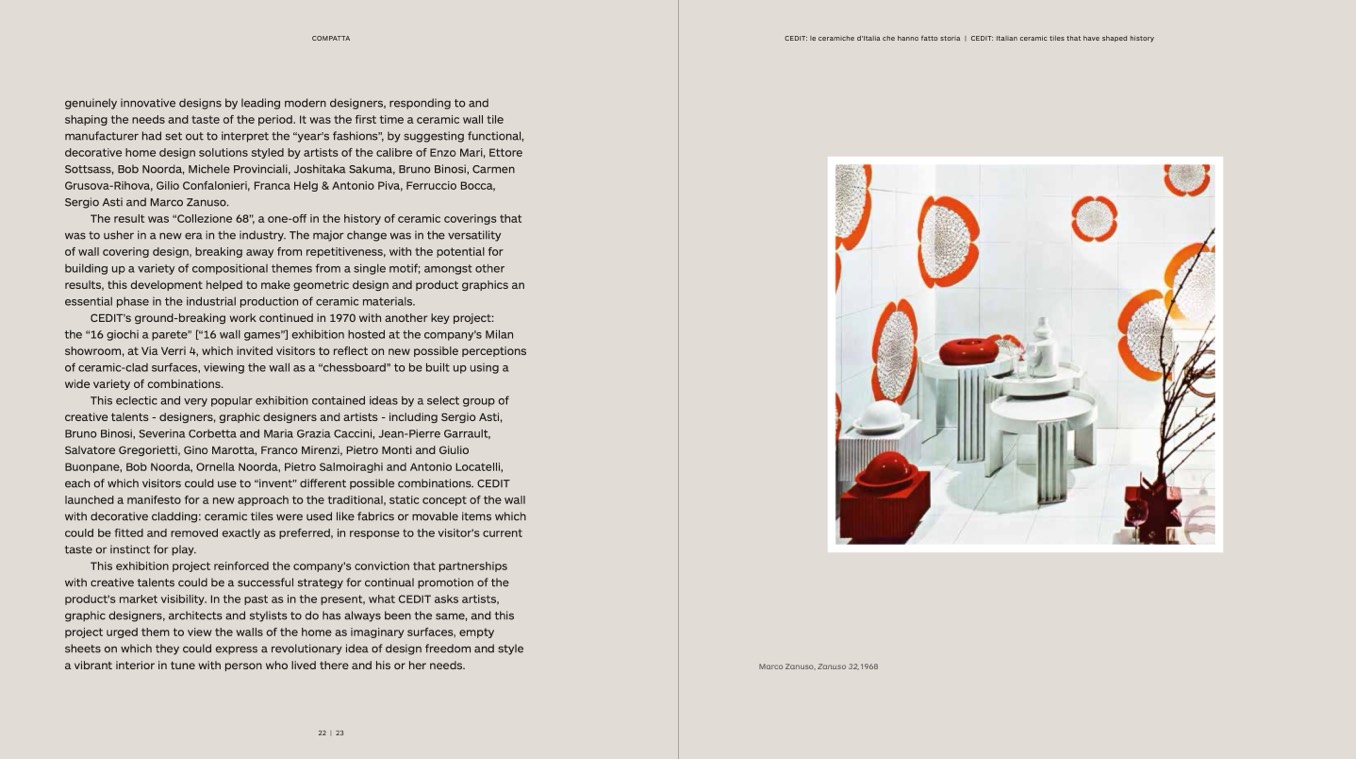
Marco Zanuso, Zanuso 32,196
8
22 | 23

