COMPATT
A
CEDIT: le ceramiche d’Italia che hanno fatto storia | CEDIT: Italian ceramic tiles that have shaped history
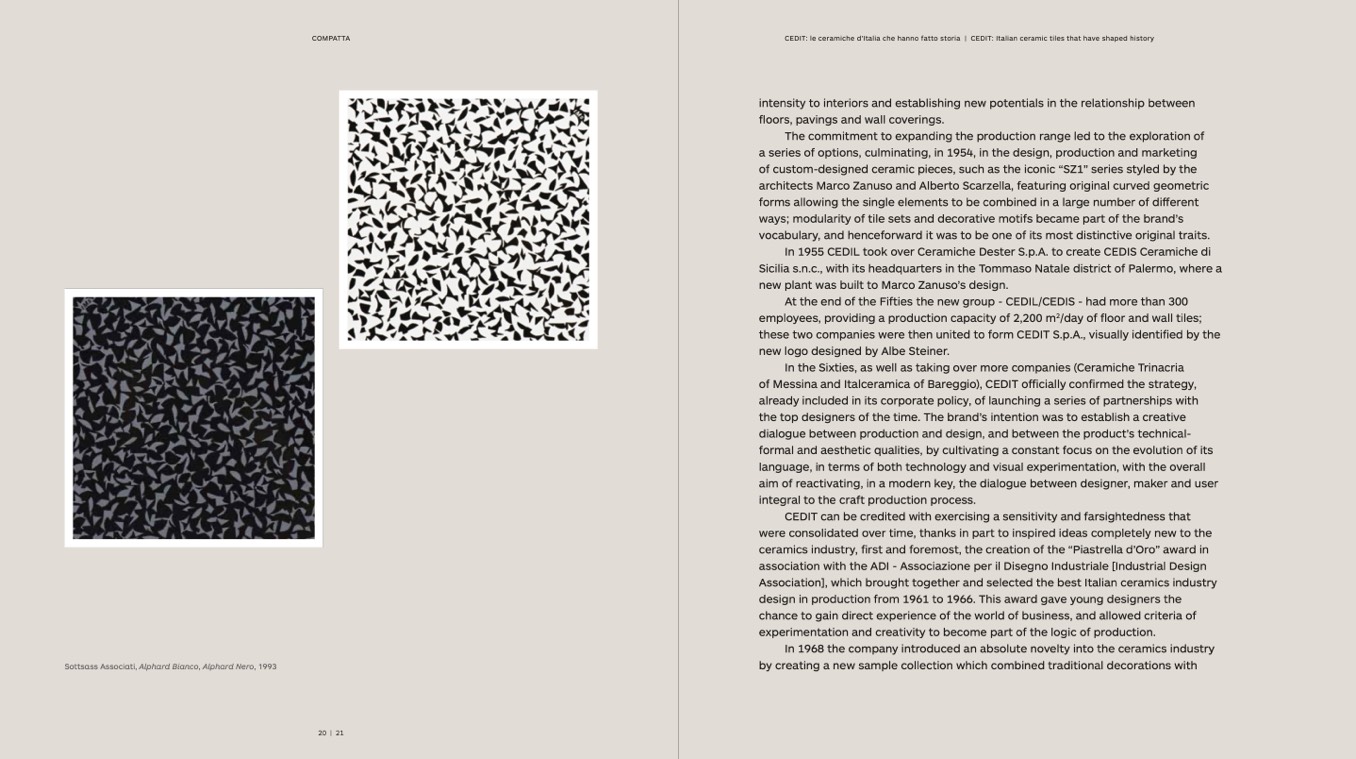
Sottsass Associati, Alphard Bianco, Alphard Nero, 1993
intensity to interiors and establishing new potentials in the relationship betwee
n
floors, pavings and wall coverings
.
The commitment to expanding the production range led to the exploration o
f
a series of options, culminating, in 1954, in the design, production and marketin
g
of custom-designed ceramic pieces, such as the iconic “SZ1” series styled by th
e
architects Marco Zanuso and Alberto Scarzella, featuring original curved geometri
c
forms allowing the single elements to be combined in a large number of di
fferen
t
ways; modularity of tile sets and decorative motifs became part of the brand’s
vocabulary, and henceforward it was to be one of its most distinctive original traits
.
In 1955 CEDIL took over Ceramiche Dester S.p.A. to create CEDIS Ceramiche d
i
Sicilia s.n.c., with its headquarters in the Tommaso Natale district of Palermo, where a
new plant was built to Marco Zanuso’s design
.
At the end of the Fifties the new group - CEDIL/CEDIS - had more than 30
0
employees, providing a production capacity of 2,200 m2/day of
floor and wall tiles
;
these two companies were then united to form CEDIT S.p.A., visually identi
fied by the
new logo designed by Albe Steiner
.
In the Sixties, as well as taking over more companies (Ceramiche Trinacria
of Messina and Italceramica of Bareggio), CEDIT of
ficially con
firmed the strategy
,
already included in its corporate policy, of launching a series of partnerships wit
h
the top designers of the time. The brand’s intention was to establish a creativ
e
dialogue between production and design, and between the product’s technical
-
formal and aesthetic qualities, by cultivating a constant focus on the evolution of it
s
language, in terms of both technology and visual experimentation, with the overal
l
aim of reactivating, in a modern key, the dialogue between designer, maker and user
integral to the craft production process.
CEDIT can be credited with exercising a sensitivity and farsightedness tha
t
were consolidated over time, thanks in part to inspired ideas completely new to th
e
ceramics industry, first and foremost, the creation of the “Piastrella d’Oro” award in
association with the ADI - Associazione per il Disegno Industriale [Industrial Desig
n
Association], which brought together and selected the best Italian ceramics industry
design in production from 1961 to 1966. This award gave young designers th
e
chance to gain direct experience of the world of business, and allowed criteria of
experimentation and creativity to become part of the logic of production
.
In 1968 the company introduced an absolute novelty into the ceramics industr
y
by creating a new sample collection which combined traditional decorations with
20 | 21

