Boiler house
Remote Alarm and Shutdown Panels
for Boilers
The requirements of PM5
Level controls
Local regulations may restrict the use of this product to below the conditions quoted.
In the interests of development and improvement of the product, we reserve the right to change the specification without notice.
© Copyright 2014
The Health and Safety Executive Guidance Note PM5 'Automatically controlled steam and hot water boilers' specifies some requirements
for remote alarms and the remote shutdown of boilers.
Some of the relevant sections are:
Paragraph 50 ......... when a boiler is not continually supervised it is not enough to have an alarm on the boiler. Alarms should be provided
at points where they can be heard by persons who are competent to take appropriate action
Paragraph 51 ........ When a boiler is subject to partial supervision it is recommended that an emergency device which will shut off the
burners should be located remote from the boiler house and should be clearly marked. (See paragraph 13).
Paragraph 13 ......... there should always be someone available on site who is competent to respond to alarms, and to take appropriate
action which at a minimum, may be to shut the boiler down safely before calling for the assistance of a trained boiler attendant.
Remote alarm panel
These requirements can be met by the installation of a 'hard wired' remote alarm panel installed at a continuously manned location such
as a telephone exchange or security point. Suitable procedures should then be established and training given on the action to take in the
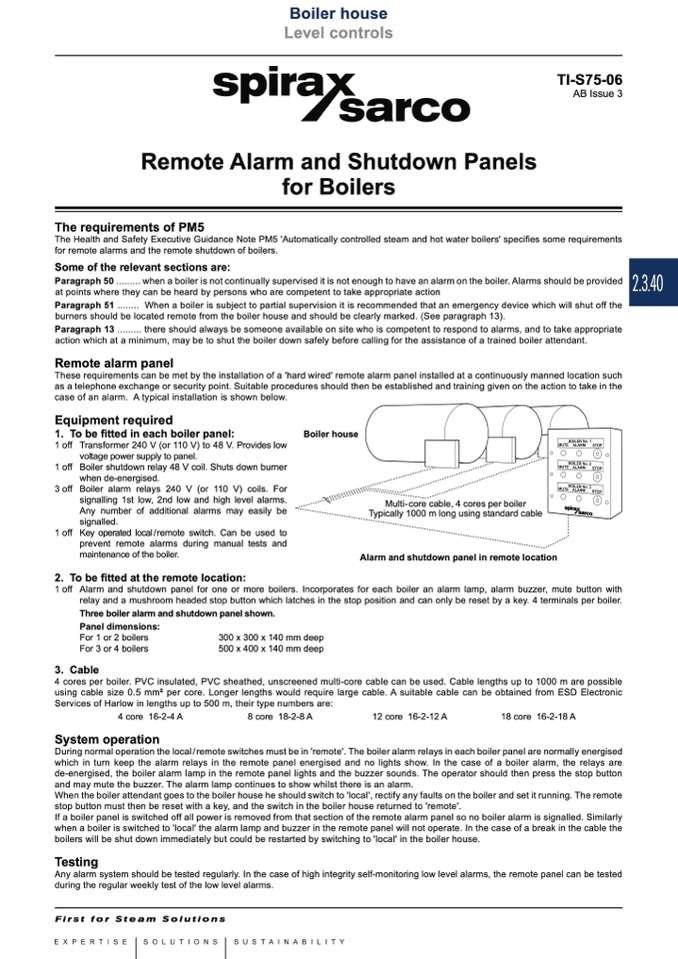
case of an alarm. A typical installation is shown below.
2.3.40
Equipment required
1. To be fitted in each boiler panel:
Boiler house
1 off
1 off
3 off
1 off
Transformer 240 V (or 110 V) to 48 V. Provides low
voltage power supply to panel.
Boiler shutdown relay 48 V coil. Shuts down burner
when de-energised.
Boiler alarm relays 240 V (or 110 V) coils. For
signalling 1st low, 2nd low and high level alarms.
Any number of additional alarms may easily be
signalled.
Key operated local/remote switch. Can be used to
prevent remote alarms during manual tests and
maintenance of the boiler.
Multi-core cable, 4 cores per boiler
Typically 1000 m long using standard cable
Alarm and shutdown panel in remote location
2. To be fitted at the remote location:
1 off Alarm and shutdown panel for one or more boilers. Incorporates for each boiler an alarm lamp, alarm buzzer, mute button with
relay and a mushroom headed stop button which latches in the stop position and can only be reset by a key. 4 terminals per boiler.
Three boiler alarm and shutdown panel shown.
Panel dimensions:
For 1 or 2 boilers
300 x 300 x 140 mm deep
For 3 or 4 boilers
500 x 400 x 140 mm deep
3. Cable
4 cores per boiler. PVC insulated, PVC sheathed, unscreened multi-core cable can be used. Cable lengths up to 1000 m are possible
using cable size 0.5 mm2 per core. Longer lengths would require large cable. A suitable cable can be obtained from ESD Electronic
Services of Harlow in lengths up to 500 m, their type numbers are:
4 core 16-2-4 A
8 core 18-2-8 A
12 core 16-2-12 A
18 core 16-2-18 A
System operation
During normal operation the local / remote switches must be in 'remote'. The boiler alarm relays in each boiler panel are normally energised
which in turn keep the alarm relays in the remote panel energised and no lights show. In the case of a boiler alarm, the relays are
de-energised, the boiler alarm lamp in the remote panel lights and the buzzer sounds. The operator should then press the stop button
and may mute the buzzer. The alarm lamp continues to show whilst there is an alarm.
When the boiler attendant goes to the boiler house he should switch to 'local', rectify any faults on the boiler and set it running. The remote
stop button must then be reset with a key, and the switch in the boiler house returned to 'remote'.
If a boiler panel is switched off all power is removed from that section of the remote alarm panel so no boiler alarm is signalled. Similarly
when a boiler is switched to 'local' the alarm lamp and buzzer in the remote panel will not operate. In the case of a break in the cable the
boilers will be shut down immediately but could be restarted by switching to 'local' in the boiler house.
Testing
Any alarm system should be tested regularly. In the case of high integrity self-monitoring low level alarms, the remote panel can be tested
during the regular weekly test of the low level alarms.
TI-S75-06
AB Issue 3

