Note: These anciliaries are not
delivered with VAD and should be
purchased separately
PN9400
series
actuator
VAD in
conjunction
with a PN9400
series actuator
VAD b :
70 mm travel for
applications that
require a higher
Kv of between:
Kv1.8toKv4.0
Water
VAD in
conjunction
with a PN9000
series actuator
VAD a :
30 mm travel Kv
0.1 to Kv 1.4 For
applications that
require a higher
Kv use a VAD b
6 m
Steam
flow
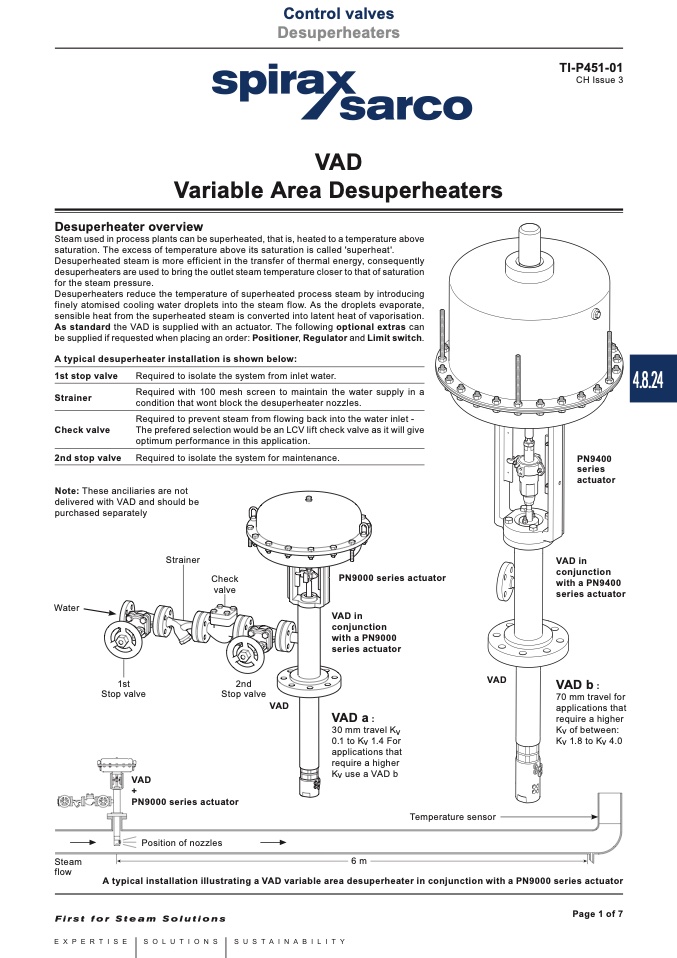
A typical installation illustrating a VAD variable area desuperheater in conjunction with a PN9000 series actuator
1st
Stop valve
VAD
VAD
Temperature sensor
Strainer
VAD
+
PN9000 series actuator
Position of nozzles
Check
valve
2nd
Stop valve
PN9000 series actuator
Control valves
Local regulations may restrict the use of this product to below the conditions quoted.
In the interests of development and improvement of the product, we reserve the right to change the specification without notice.
Desuperheaters
© Copyright 2016
VAD
Variable Area Desuperheaters
Desuperheater overview
Steam used in process plants can be superheated, that is, heated to a temperature above
saturation. The excess of temperature above its saturation is called 'superheat'.
Desuperheated steam is more efficient in the transfer of thermal energy, consequently
desuperheaters are used to bring the outlet steam temperature closer to that of saturation
for the steam pressure.
Desuperheaters reduce the temperature of superheated process steam by introducing
finely atomised cooling water droplets into the steam flow. As the droplets evaporate,
sensible heat from the superheated steam is converted into latent heat of vaporisation.
As standard the VAD is supplied with an actuator. The following optional extras can
be supplied if requested when placing an order: Positioner, Regulator and Limit switch.
A typical desuperheater installation is shown below:
1st stop valve
Strainer
Check valve
2nd stop valve
Required to isolate the system from inlet water.
Required with 100 mesh screen to maintain the water supply in a
condition that wont block the desuperheater nozzles.
Required to prevent steam from flowing back into the water inlet -
The prefered selection would be an LCV lift check valve as it will give
optimum performance in this application.
Required to isolate the system for maintenance.
4.8.24
TI-P451-01
CH Issue 3
Page 1 of 7

