Control valves
Local regulations may restrict the use of this product to below the conditions quoted.
Desuperheaters
In the interests of development and improvement of the product, we reserve the right to change the specification without notice. © Copyright 2016
TI-P475-06
CH Issue 3
Desuperheater
Online Program Sizing Guidance
Desuperheater overview
In typical process plants, process steam is usually superheated,
or heated to a temperature above saturation. The difference
between the saturation temperature and the actual temperature
of the steam is called 'superheat'.
Desuperheated steam is more efficient in the transfer of thermal
energy, consequently desuperheaters are used to bring the outlet
degree of superheat closer to that of saturation.
Desuperheaters reduce the temperature of superheated process
steam by introducing finely atomized cooling water droplets into
the steam flow. As the droplets evaporate, sensible heat from
the superheated steam is converted into latent heat of
vaporization.
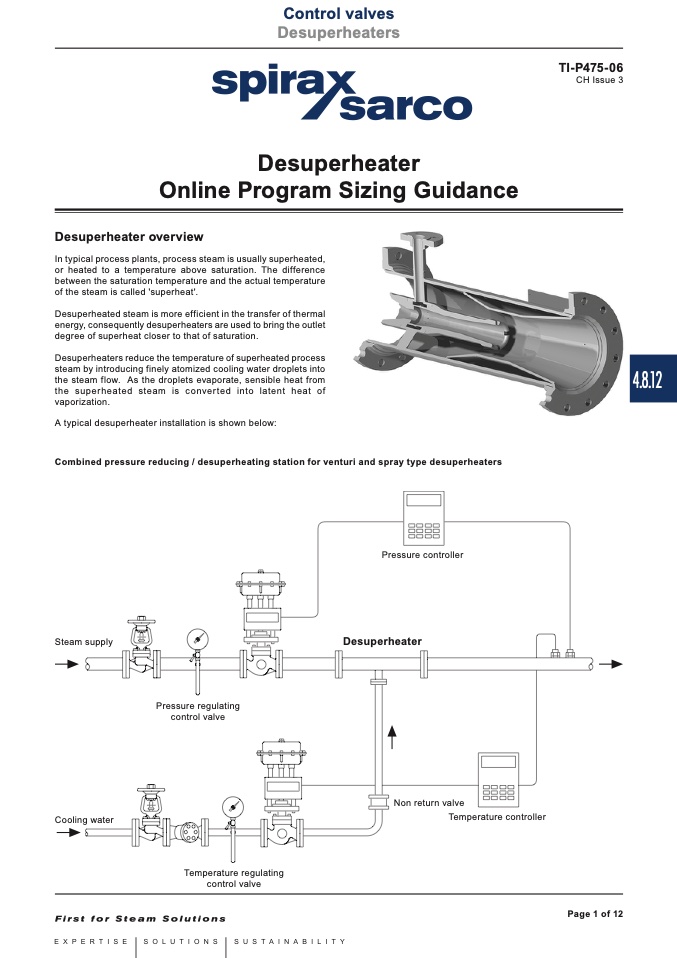
A typical desuperheater installation is shown below:
Combined pressure reducing / desuperheating station for venturi and spray type desuperheaters
Steam supply
Pressure controller
Desuperheater
Pressure regulating
control valve
Cooling water
Non return valve
Temperature controller
Temperature regulating
control valve
Page 1 of 12
4.8.12

