Control valves
Desuperheaters
4.8.7
Sizing and selection
There are a number of factors which must be considered in determining the best type of desuperheater for each application. Such
factors are:-
1. Residual superheat.
2. Turndown.
3. Accuracy of final temperature.
4. Available pressure drop.
5. Cooling water pressure.
6. Auxiliary higher pressure steam available for atomising.
7. Cost.
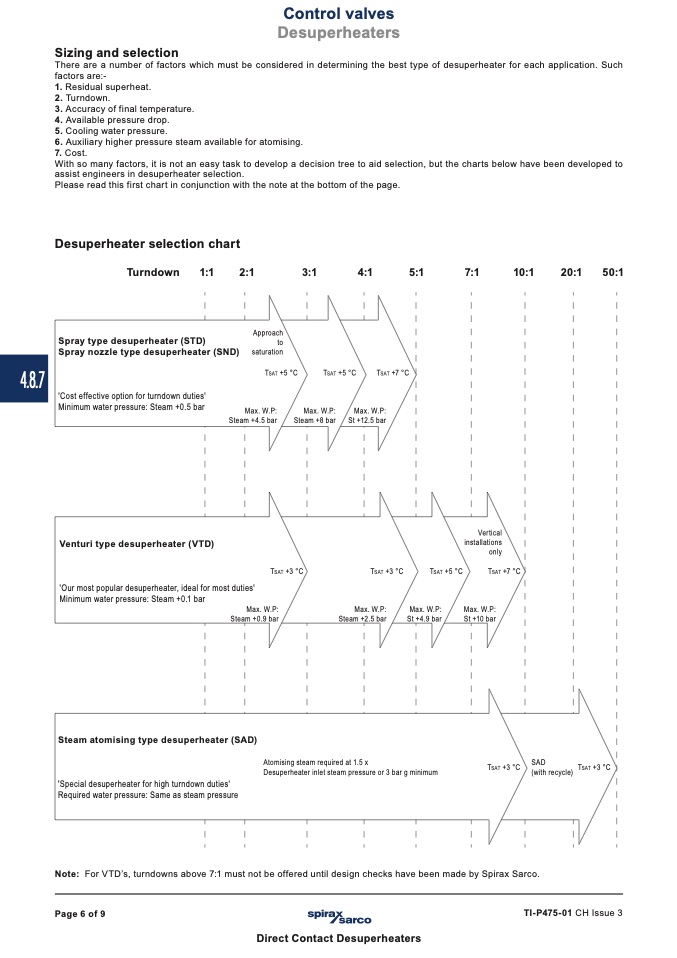
With so many factors, it is not an easy task to develop a decision tree to aid selection, but the charts below have been developed to
assist engineers in desuperheater selection.
Please read this first chart in conjunction with the note at the bottom of the page.
Desuperheater selection chart
Turndown
1:1
2:1
3:1
4:1
Tsat +5 °C
5:1
7:1
10:1
20:1
50:1
Approach
to
Spray nozzle type desuperheater (SND) saturation
Spray type desuperheater (STD)
'Cost effective option for turndown duties'
Minimum water pressure: Steam +0.5 bar
Venturi type desuperheater (VTD)
Max. W.P:
Steam +4.5 bar
Tsat +3°C
Max. W.P:
Steam +0.9 bar
Tsat +5 °C
Tsat +7 °C
Max. W.P:
Max. W.P:
Steam +8 bar
St +12.5 bar
Tsat +3°C
Max. W.P:
Steam +2.5 bar
'Our most popular desuperheater, ideal for most duties'
Minimum water pressure: Steam +0.1 bar
Tsat +5°C
Max. W.P:
St +4.9 bar
Vertical
installations
only
Tsat +7°C
Max. W.P:
St +10 bar
Steam atomising type desuperheater (SAD)
'Special desuperheater for high turndown duties'
Required water pressure: Same as steam pressure
Atomising steam required at 1.5 x
Desuperheater inlet steam pressure or 3 bar g minimum
Tsat +3 °C
SAD
(with recycle)
Tsat +3 °C
Note: For VTD’s, turndowns above 7:1 must not be offered until design checks have been made by Spirax Sarco.
Page 6 of 9
TI-P475-01 CH Issue 3
Direct Contact Desuperheaters

