Boiler house
Level controls
Local regulations may restrict the use of this product to below the conditions quoted.
In the interests of development and improvement of the product, we reserve the right to change the specification without notice.
© Copyright 2016
AI-P402-13
AB Issue 8
LCS4000
Level Control Systems
Installation and testing
of self-monitoring low level alarms and boiler feedwater control/high alarm
Typical installation
This document does not contain sufficient information to install
the system safely. See the Installation and Maintenance
Instructions supplied with the products for full details.
The Spirax Sarco LCS4000 boiler water level control and alarm
system is suitable for automatically controlled steam boilers and
provides the control and alarm functions specified by British
Standards in BS 12953 and by the SAFed and CEA, in consultation
with the Health & Safety Executive, in BG01.
The low level alarms are of the high integrity type and whilst a trained
boiler attendant should check the plant daily, he need not be on site
at all times. There should, however, always be someone available
on site such as a watchman or porter who is suitably trained to
respond to alarms and take appropriate action.
The level controls and level alarms are probably the most important
controls on the boiler for ensuring safety and should only be installed
and maintained by suitable trained personnel. Spirax Sarco can
install, commission and provide a regular maintenance service.
Note: Consult Spirax Sarco if conductivity
is less than 100 μS/cm and is likely to
vary by more than 2:1.
High integrity self-monitoring level alarms do not require daily testing
but the weekly test should be carried out or witnessed by a
responsible person who appreciates the hazards involved and has
been suitably trained in the safe operation of the boiler and its
controls. At no time during the test should the water be lowered to
the extent that it disappears from the gauge glass.
1. With the feedwater isolated, allow the water level to fall by
evaporation until the burner shuts down at 1st low alarm.
2. Blow down the boiler until the 2nd low alarm sounds and the
burner controls go to lockout.
3. Raise the water level to normal, reset the lockout and allow the
burner to refire. Press the test button (or the externally wired
button if fitted) on the LC3000 for 2nd low to ensure that the
burner shuts down at the 2nd low level alarm.
4. Under hand control raise the water level to the high alarm level.
Check that the high alarm sounds.
5. Return all valves and controls to normal and monitor the boiler
until satisfied that it is operating normally.
The Health and Safety Executive recommend from experience that
the boiler controls should be serviced at least at quarterly intervals.
Where the regular tests are carried out properly in a well run boiler
house with good water treatment, it may be that only an annual
inspection of the probes etc. is required. This is a matter, however,
for the user to decide in liaison with his insurance company inspector
in order to determine a sensible inspection programme to suit the
individual boiler plant.
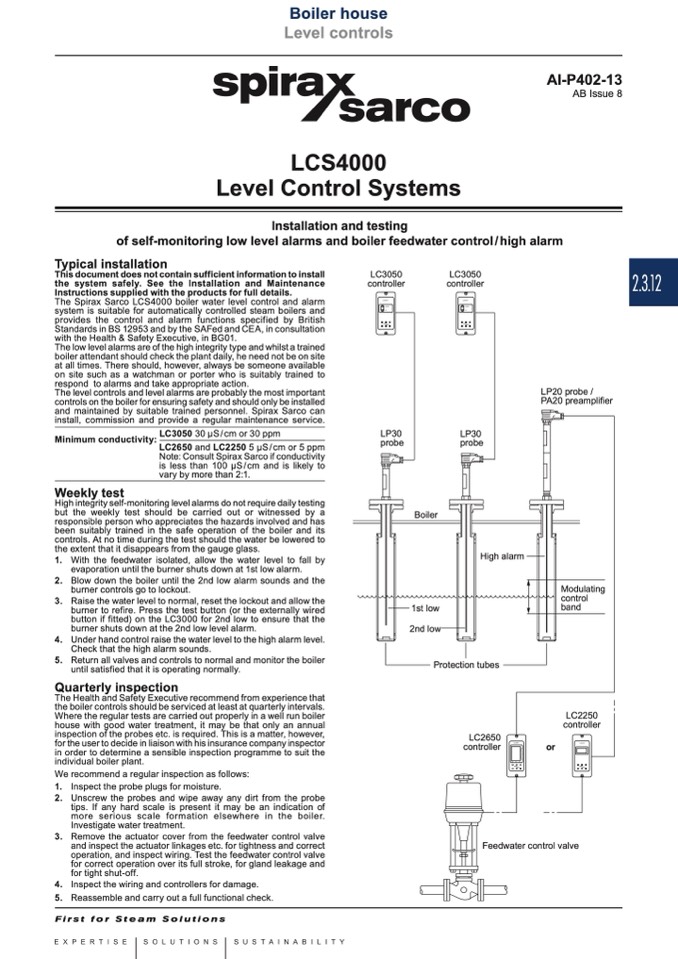
LC3050
controller
LC3050
controller
LC3050
ALARM
OK
AL
LP30
probe
LC3050
ALARM
OK
AL
LP20 probe /
PA20 preamplifier
Minimum conductivity:
LC3050 30 μS/cm or 30 ppm
LC2650 and LC2250 5 μS/cm or 5 ppm
LP30
probe
Weekly test
Boiler
High alarm
1st low
2nd low
Protection tubes
Quarterly inspection
Modulating
control
band
LC2250
controller
LC2250
OK
LC2650
controller
LC2650
%
0
SP
PV
AL
OK
or
100
50
AL
We recommend a regular inspection as follows:
1. Inspect the probe plugs for moisture.
2. Unscrew the probes and wipe away any dirt from the probe
tips. If any hard scale is present it may be an indication of
more serious scale formation elsewhere in the boiler.
Investigate water treatment.
3. Remove the actuator cover from the feedwater control valve
and inspect the actuator linkages etc. for tightness and correct
operation, and inspect wiring. Test the feedwater control valve
for correct operation over its full stroke, for gland leakage and
for tight shut-off.
4. Inspect the wiring and controllers for damage.
5. Reassemble and carry out a full functional check.
Feedwater control valve
2.3.12

