General information
Steam traps - International standards
Face-to-face dimensions for flanged automatic
steam traps
EN 26554 : 1991 ISO 6554 : 1980
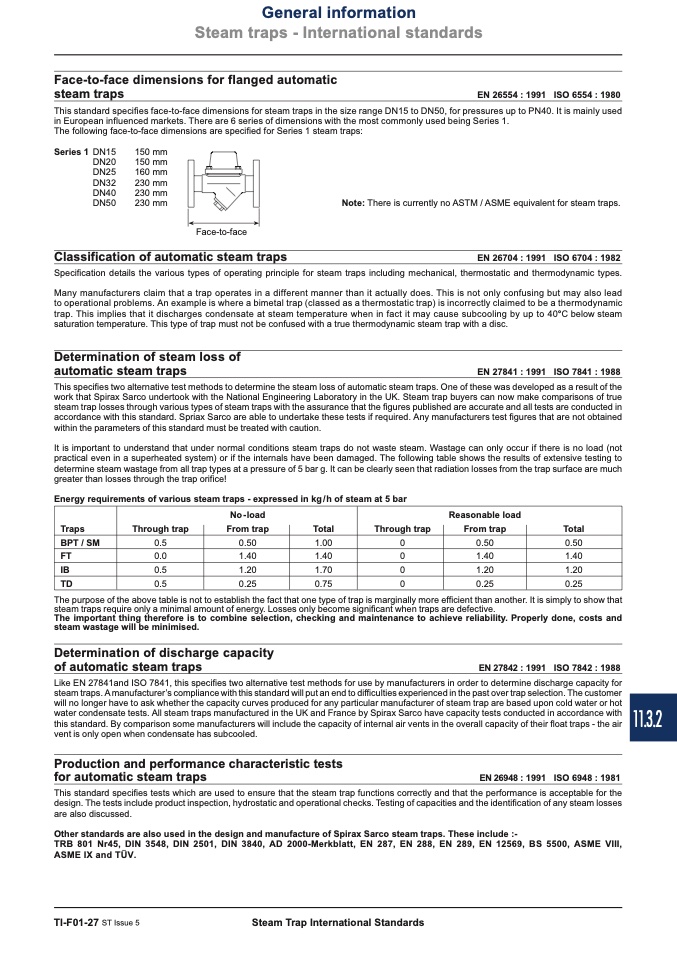
This standard specifies face-to-face dimensions for steam traps in the size range DN15 to DN50, for pressures up to PN40. It is mainly used
in European influenced markets. There are 6 series of dimensions with the most commonly used being Series 1.
The following face-to-face dimensions are specified for Series 1 steam traps:
Series 1 DN15
150 mm
DN20
150 mm
DN25
160 mm
DN32
230 mm
DN40
230 mm
DN50
230 mm
Note: There is currently no ASTM / ASME equivalent for steam traps.
EN 26704 : 1991 ISO 6704 : 1982
Classification of automatic steam traps
Face-to-face
Specification details the various types of operating principle for steam traps including mechanical, thermostatic and thermodynamic types.
Many manufacturers claim that a trap operates in a different manner than it actually does. This is not only confusing but may also lead
to operational problems. An example is where a bimetal trap (classed as a thermostatic trap) is incorrectly claimed to be a thermodynamic
trap. This implies that it discharges condensate at steam temperature when in fact it may cause subcooling by up to 40°C below steam
saturation temperature. This type of trap must not be confused with a true thermodynamic steam trap with a disc.
Determination of steam loss of
automatic steam traps
EN 27841 : 1991 ISO 7841 : 1988
This specifies two alternative test methods to determine the steam loss of automatic steam traps. One of these was developed as a result of the
work that Spirax Sarco undertook with the National Engineering Laboratory in the UK. Steam trap buyers can now make comparisons of true
steam trap losses through various types of steam traps with the assurance that the figures published are accurate and all tests are conducted in
accordance with this standard. Spriax Sarco are able to undertake these tests if required. Any manufacturers test figures that are not obtained
within the parameters of this standard must be treated with caution.
It is important to understand that under normal conditions steam traps do not waste steam. Wastage can only occur if there is no load (not
practical even in a superheated system) or if the internals have been damaged. The following table shows the results of extensive testing to
determine steam wastage from all trap types at a pressure of 5 bar g. It can be clearly seen that radiation losses from the trap surface are much
greater than losses through the trap orifice!
Energy requirements of various steam traps - expressed in kg/h of steam at 5 bar
The purpose of the above table is not to establish the fact that one type of trap is marginally more efficient than another. It is simply to show that
steam traps require only a minimal amount of energy. Losses only become significant when traps are defective.
The important thing therefore is to combine selection, checking and maintenance to achieve reliability. Properly done, costs and
steam wastage will be minimised.
Determination of discharge capacity
of automatic steam traps
EN 27842 : 1991 ISO 7842 : 1988
Like EN 27841and ISO 7841, this specifies two alternative test methods for use by manufacturers in order to determine discharge capacity for
steam traps. A manufacturer’s compliance with this standard will put an end to difficulties experienced in the past over trap selection. The customer
will no longer have to ask whether the capacity curves produced for any particular manufacturer of steam trap are based upon cold water or hot
water condensate tests. All steam traps manufactured in the UK and France by Spirax Sarco have capacity tests conducted in accordance with
this standard. By comparison some manufacturers will include the capacity of internal air vents in the overall capacity of their float traps - the air
vent is only open when condensate has subcooled.
Production and performance characteristic tests
for automatic steam traps
EN 26948 : 1991 ISO 6948 : 1981
This standard specifies tests which are used to ensure that the steam trap functions correctly and that the performance is acceptable for the
design. The tests include product inspection, hydrostatic and operational checks. Testing of capacities and the identification of any steam losses
are also discussed.
Other standards are also used in the design and manufacture of Spirax Sarco steam traps. These include :-
TRB 801 Nr45, DIN 3548, DIN 2501, DIN 3840, AD 2000-Merkblatt, EN 287, EN 288, EN 289, EN 12569, BS 5500, ASME VIII,
ASME IX and TÜV.
Traps
No - load
Through trap
From trap
Total
Reasonable load
Through trap
From trap
Total
BPT / SM
0.5
0.50
1.00
0
0.50
0.50
FT
0.0
1.40
1.40
0
1.40
1.40
IB
0.5
1.20
1.70
0
1.20
1.20
TD
0.5
0.25
0.75
0
0.25
0.25
11.3.2
TI-F01-27 ST Issue 5
Steam Trap International Standards

