Did you draw a lot as a child?
What were the first drawings you
remember creating? Like everyone
else, I started drawing before
writing. I was addicted to it; putting
onto paper what I had going on in
my mind. I haven’t stopped there –
and I love that. It's a viral emotion.
My first drawings were images
of skiing, BMX bikes and cars. I
never sought to be a professional
draughtsman. Instagram, clients
and art collectors have marked
a new chapter in my life and my
drawings have evolved from here.
Which aspects of your background
and upbringing in the French Alps
have shaped your artwork today?
After endless hours, weeks and years
of reading and working with images,
my eyes and my hands focus on
what they reveal to me, what I see,
and what I want to see. Strangely
enough, I feel very much like a
photographer – only with a pen
or a brush.
How has your style evolved over
time? Style has its own way; it’s a
constant and long journey with a
lot of work. And some days you see
something that was there since the
beginning, but you didn’t see or
understand until now. Style evolves
slowly, step by step. Good things
take time. Four years ago, design
was my main business focus and I
needed to go back to drawings. So,
at the end of day, when everyone
was sleeping in the house, my
smartphone was turned off, no
e-mails – I was just drawing. I didn’t
use colours because I can't see them
very well. I did it simply with a black
pen, fine or calligraphic, depending
on my mood, and without any
precise subject or expectation. I
would just draw while thinking
about something else. My hand
is a filter with its own sensibility.
Good things take time.
I have to control it and let it flow,
dance, follow its own way. It's all
about control: the encounter between
control and uncontrollable, as Richard
Avedon said.
Your medium merges illustration
with design. How do you describe it?
Do you see yourself as an artist or
a designer? My favourite role is not
having a specific one. My artwork
is about drawing. My main focus is
design – even though this is less and
less the case. Each field provides a
new way of looking at the other one,
and this nurtures each aspect for me.
Because they are all so very different:
drawing stops on the paper, but paper
is just the beginning of a design.
Drawing is always part of being a
designer. It is the first word – the
starting point – which then develops
into several sentences and eventually
becomes the answers we were looking
for. Then it turns into something
else: from modelling to the final
tangible product.
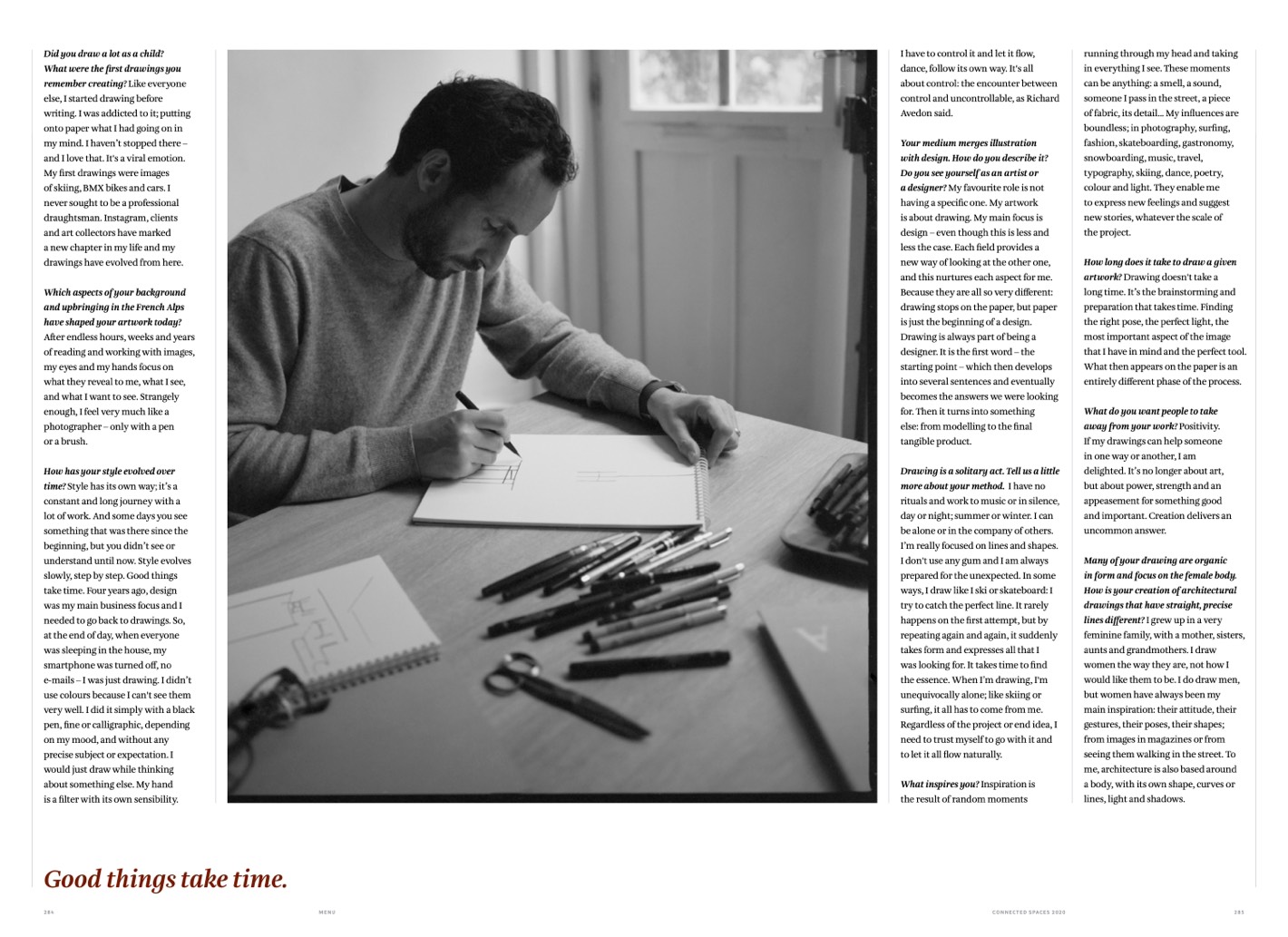
Drawing is a solitary act. Tell us a little
more about your method. I have no
rituals and work to music or in silence,
day or night; summer or winter. I can
be alone or in the company of others.
I’m really focused on lines and shapes.
I don't use any gum and I am always
prepared for the unexpected. In some
ways, I draw like I ski or skateboard: I
try to catch the perfect line. It rarely
happens on the first attempt, but by
repeating again and again, it suddenly
takes form and expresses all that I
was looking for. It takes time to find
the essence. When I’m drawing, I'm
unequivocally alone; like skiing or
surfing, it all has to come from me.
Regardless of the project or end idea, I
need to trust myself to go with it and
to let it all flow naturally.
What inspires you? Inspiration is
the result of random moments
running through my head and taking
in everything I see. These moments
can be anything: a smell, a sound,
someone I pass in the street, a piece
of fabric, its detail... My influences are
boundless; in photography, surfing,
fashion, skateboarding, gastronomy,
snowboarding, music, travel,
typography, skiing, dance, poetry,
colour and light. They enable me
to express new feelings and suggest
new stories, whatever the scale of
the project.
How long does it take to draw a given
artwork? Drawing doesn't take a
long time. It’s the brainstorming and
preparation that takes time. Finding
the right pose, the perfect light, the
most important aspect of the image
that I have in mind and the perfect tool.
What then appears on the paper is an
entirely different phase of the process.
What do you want people to take
away from your work? Positivity.
If my drawings can help someone
in one way or another, I am
delighted. It’s no longer about art,
but about power, strength and an
appeasement for something good
and important. Creation delivers an
uncommon answer.
Many of your drawing are organic
in form and focus on the female body.
How is your creation of architectural
drawings that have straight, precise
lines different? I grew up in a very
feminine family, with a mother, sisters,
aunts and grandmothers. I draw
women the way they are, not how I
would like them to be. I do draw men,
but women have always been my
main inspiration: their attitude, their
gestures, their poses, their shapes;
from images in magazines or from
seeing them walking in the street. To
me, architecture is also based around
a body, with its own shape, curves or
lines, light and shadows.
284
MENU
CONNECTED SPACES 2020
285

