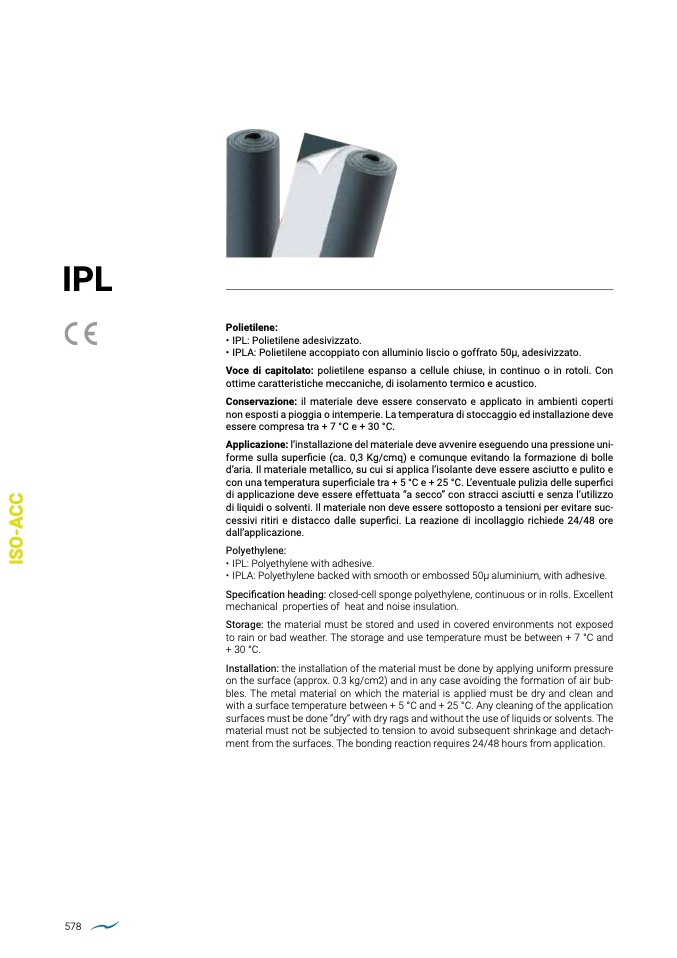
IPL
578
Polietilene:
• IPL: Polietilene adesivizzato.
• IPLA: Polietilene accoppiato con alluminio liscio o goffrato 50μ, adesivizzato.
Voce di capitolato: polietilene espanso a cellule chiuse, in continuo o in rotoli. Con
ottime caratteristiche meccaniche, di isolamento termico e acustico.
Conservazione: il materiale deve essere conservato e applicato in ambienti coperti
non esposti a pioggia o intemperie. La temperatura di stoccaggio ed installazione deve
essere compresa tra + 7 °C e + 30 °C.
Applicazione: l’installazione del materiale deve avvenire eseguendo una pressione uni-
forme sulla superficie (ca. 0,3 Kg/cmq) e comunque evitando la formazione di bolle
d’aria. Il materiale metallico, su cui si applica l’isolante deve essere asciutto e pulito e
con una temperatura super
ficiale tra + 5 °C e + 25 °C. L’eventuale pulizia delle superfici
di applicazione deve essere effettuata “a secco” con stracci asciutti e senza l’utilizzo
di liquidi o solventi. Il materiale non deve essere sottoposto a tensioni per evitare suc-
cessivi ritiri e distacco dalle super
fici. La reazione di incollaggio richiede 24/48 ore
dall’applicazione.
Polyethylene:
• IPL: Polyethylene with adhesive.
• IPLA: Polyethylene backed with smooth or embossed 50μ aluminium, with adhesive.
Specification heading: closed-cell sponge polyethylene, continuous or in rolls. Excellent
mechanical properties of heat and noise insulation.
Storage: the material must be stored and used in covered environments not exposed
to rain or bad weather. The storage and use temperature must be between + 7 °C and
+ 30 °C.
Installation: the installation of the material must be done by applying uniform pressure
on the surface (approx. 0.3 kg/cm2) and in any case avoiding the formation of air bub-
bles. The metal material on which the material is applied must be dry and clean and
with a surface temperature between + 5 °C and + 25 °C. Any cleaning of the application
surfaces must be done “dry” with dry rags and without the use of liquids or solvents. The
material must not be subjected to tension to avoid subsequent shrinkage and detach-
ment from the surfaces. The bonding reaction requires 24/48 hours from application.
I
S
O
-
A
C
C

